
New Images Reveal Interstellar Comet 3I/ATLAS Ejecting a Massive Jet
Newly released images of the interstellar comet 3I/ATLAS appear to show an enormous jet of gas and dust being ejected toward the sun, a behavior typical of comets. Discovered in late June and confirmed by NASA in early July, this comet originates from an unknown star system far beyond our own. It is only the third interstellar object ever detected. With a width ranging between 3 and 7 miles (5 to 11 kilometers), it is the largest interstellar object to cross our path and may be the oldest, potentially dating back billions of years before the formation of the sun.
These and other peculiarities have led some researchers to controversially suggest that the object could be an alien spacecraft sent to observe us. However, the majority of scientists argue that 3I/ATLAS is simply a high-speed comet behaving as expected. The new images, captured on August 2 by the Two-meter Twin Telescope (TTT) at the Teide Observatory in Spain's Canary Islands, further support the idea that the object has a natural origin.
The composite image, created by combining 159 exposures lasting 50 seconds each, shows the icy body (or nucleus) of 3I/ATLAS as a large, black dot surrounded by a white glow. A sudden, fan-shaped break in this glowing ring indicates where a large, high-speed jet of material is blasting off the comet toward the sun. This image was shared on the transient object monitoring site The Astronomer’s Telegram on October 15 but has not yet been published in a peer-reviewed study.
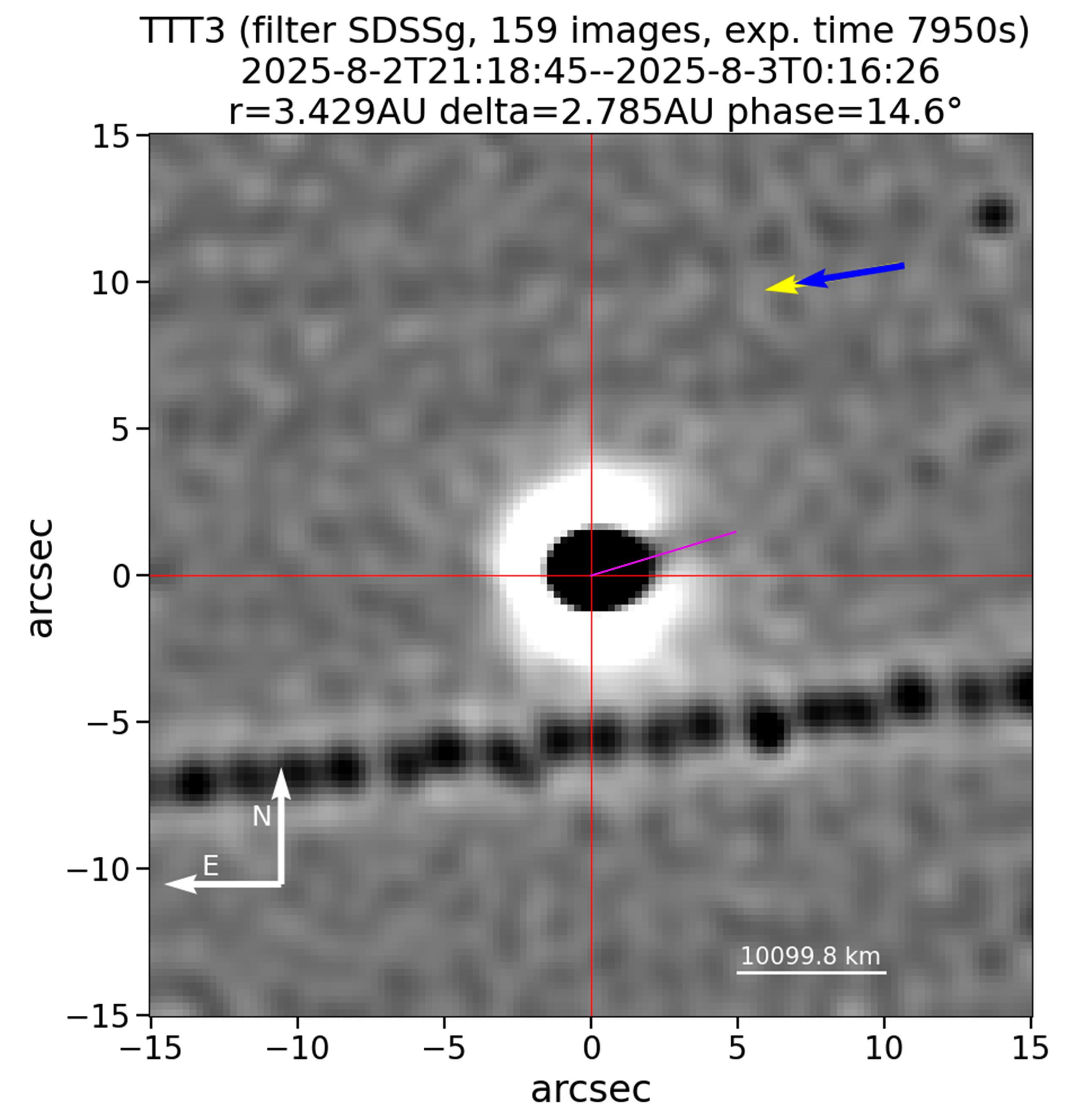
Comets are known for their glowing tails of ionized gas, which can stretch for hundreds of millions of miles in the opposite direction of the sun. Comet jets, however, are much smaller and can point toward the sun. While a jet of dust aimed at the sun might seem unusual, it is a normal feature of a comet’s structure, according to Miquel Serra-Ricart, an astrophysicist and chief science officer at the Teide Observatory's Light Bridges research institution.
“This is the usual,” Serra-Ricart said in an email to Live Science. “Jets are pointing to the sunward direction and the comet’s tail in the anti-solar direction.”
This happens because comets heat up as they approach the sun, but not evenly. The sun-facing side warms the fastest, and if a weak spot on the surface heats enough, sublimated gases can blast out like a geyser, sending cometary material thousands of miles toward the sun.
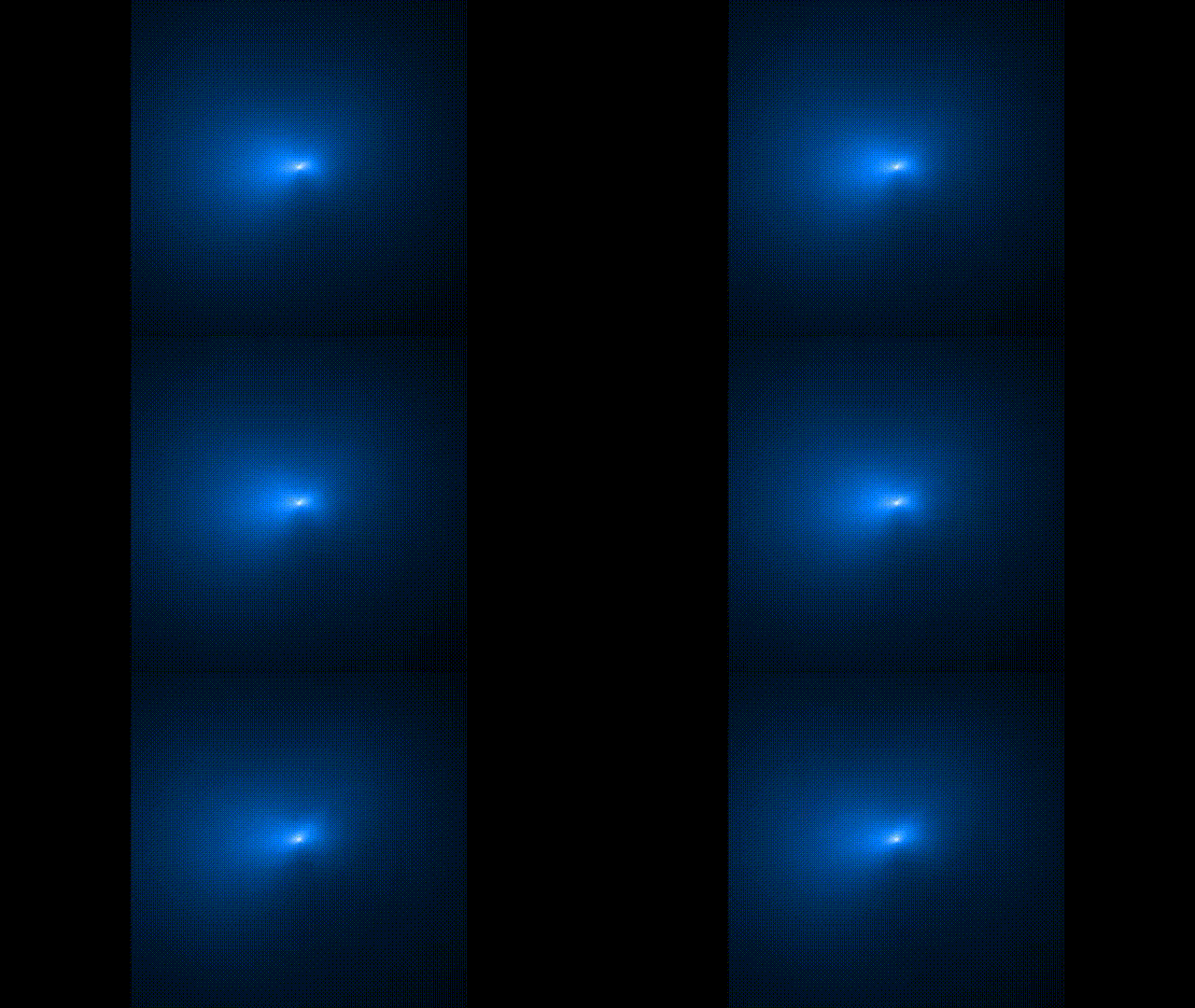
As the comet’s nucleus rotates, the jet can take on a fan shape, similar to what is seen in the new TTT image. The famous naked-eye comet NEOWISE also developed fan-like jets after its close flyby of the sun in 2020, as observed by the Hubble Space Telescope.
Some of the jet material ends up in the comet’s coma, the glowing plume surrounding the nucleus, while some may be forced into the tail by radiation pressure from the solar wind. This explains why comets can have both a sun-facing jet and an anti-sunward tail simultaneously — no alien technology needed.
It is unclear how far this newly discovered jet extends, but Serra-Ricart estimates it could stretch roughly 6,200 miles (10,000 km) from 3I/ATLAS’ surface. The jet is likely composed mostly of dust particles and carbon dioxide, consistent with the makeup of the large gassy plume detected around the comet by the James Webb Space Telescope in August.
3I/ATLAS swooped past Mars on October 3 and is currently approaching its closest point to the sun (perihelion), which it will reach on October 29. The comet is now on the far side of the sun and won’t be visible from Earth again until mid-November. When it reemerges, astronomers will have a rare opportunity to observe how the mysterious visitor has changed after its encounter with the sun and how much its jet and tail may have grown.
Post a Comment