
A New Frontier in Quasicrystal Research
Researchers have made a groundbreaking discovery by creating the first reconfigurable polariton 2D quasicrystal. This achievement, led by a team from the Skolkovo Institute of Science and Technology (Skoltech) in collaboration with scientists from the University of Iceland, the University of Warsaw, and the Institute of Spectroscopy of the Russian Academy of Sciences, has unveiled new possibilities for studying exotic phenomena like supersolids and superfluidity in non-periodic systems.
The study, published in Science Advances, involved the use of exciton-polaritons—hybrid quasiparticles that are part light and part matter. By arranging these polaritons in a Penrose tiling, a well-known aperiodic pattern with five-fold symmetry, the researchers observed the formation of a macroscopic coherent state where individual nodes synchronized in a unique way, unlike what is seen in traditional periodic crystals.
The Fascination with Aperiodic Structures
Quasicrystals have intrigued scientists since their controversial discovery by Dan Shechtman in 1984, which earned him the Nobel Prize. These structures possess a paradoxical nature: they lack the repeating patterns of regular crystals but still exhibit strict long-range order. Their unique properties have already found practical applications, such as in durable, nonstick coatings for kitchenware and razors, making them more resilient over time.
In the future, quasicrystals may also contribute to better insulation for buildings and advanced LED technologies. From a fundamental perspective, they reveal fractal energy spectra and unusual wave transport properties, including Anderson localization of light. However, their behavior in nonequilibrium, laser-driven quantum fluids remained largely unexplored until now.
Experiment: Painting with Light
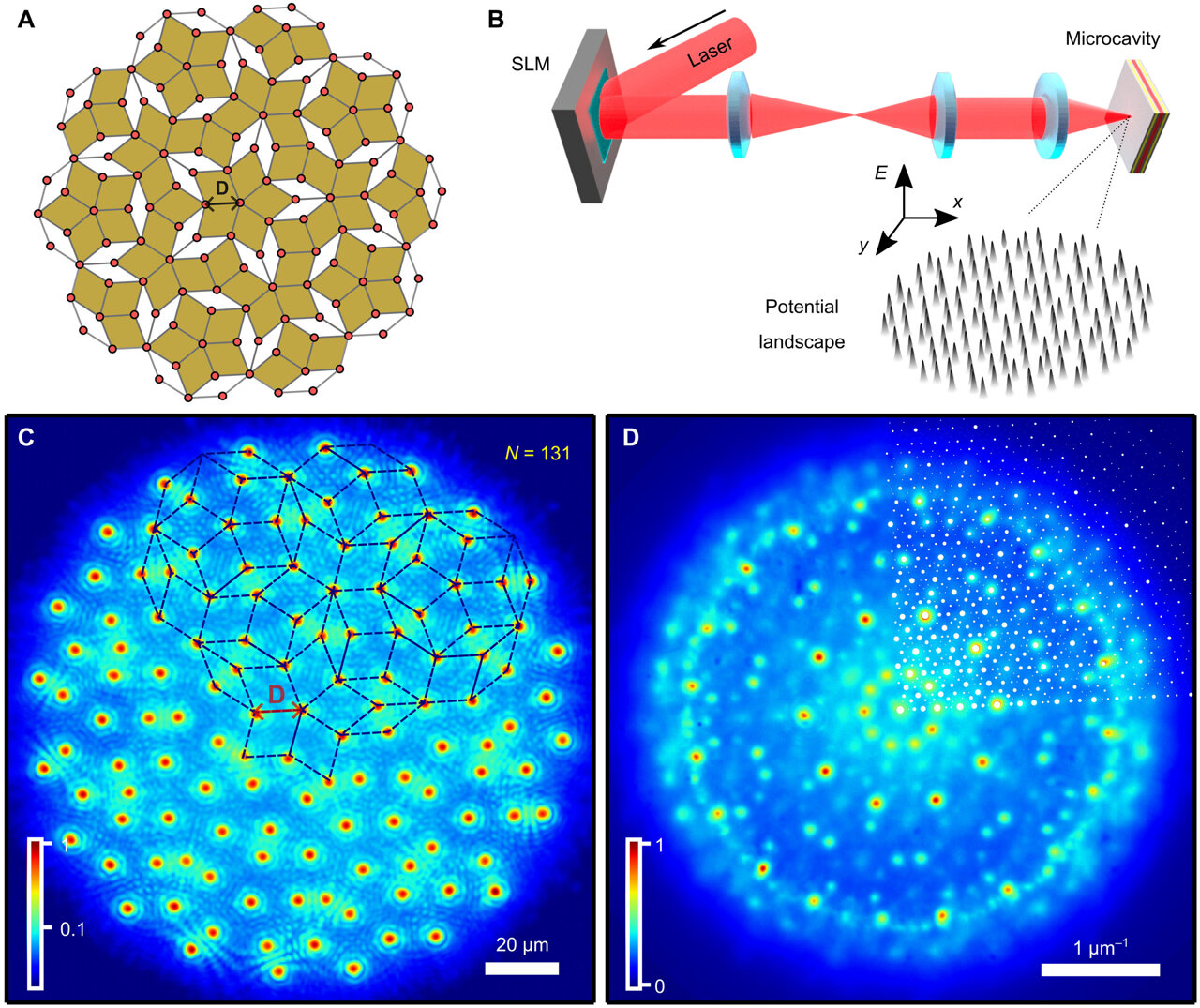
To create their quasicrystal, the Skoltech researchers employed an advanced optical technique. They shaped a laser beam using a spatial light modulator to project a Penrose tiling pattern onto a semiconductor microcavity sample. This process created a potential landscape for interacting polaritons.
When the laser power was increased beyond a certain threshold, exciton-polariton condensates formed at each node of the tiling. Due to their hybrid nature, these condensates were not confined to the laser-pumped spots but could flow ballistically across the sample, interacting and interfering with one another. By adjusting the laser power, the number of nodes, and the spacing between them, the researchers achieved precise control over the polariton system in aperiodic settings.
Long-Range Order and Nontrivial Phases
One of the most significant findings was the spontaneous formation of macroscopic coherence across the entire aperiodic structure, extending over distances 100 times larger than a single condensate. This long-range order was confirmed by the appearance of sharp, tenfold symmetric Bragg peaks in the momentum-space photoluminescence—a clear indicator of quasicrystalline order.
Using a sensitive interferometry technique, the researchers measured the relative phases between the condensates. They discovered that the nodes synchronized with phase differences that were neither perfectly in phase nor perfectly out of phase, a phenomenon not observed in periodic lattices. This "nontrivial phase locking" is a direct result of the complex, aperiodic environment of the Penrose tiling.
"The results are literally beautiful," said Sergey Alyatkin, the first author of the paper and an assistant professor at the Photonics Center of Skoltech. "We found a complex interference pattern in the plane of the microcavity sample as polaritons from different nodes of the Penrose mosaic ballistically propagate and interact."
Future Implications
The researchers believe that this optical approach paves the way for further physical realization of an aperiodic monotile recently discovered by mathematicians. This monotile requires only a single shape of a tile to cover the entire plane without any gaps. Before this discovery, it was thought that a 2D quasicrystal needed at least two distinct shapes of tiles, such as the Penrose quasicrystal composed of thin and thick rhombuses, which was used in this study.
This breakthrough opens new avenues for exploring the behavior of quantum fluids in aperiodic environments and could lead to innovative applications in materials science and quantum technology.
Post a Comment