
You may have noticed that middle managers' jobs are disappearing. Major employers — ranging from Amazon and Meta to companies like Walmart, UPS, and Estée Lauder — have made headlines in the post-Covid era for cutting layers of middle management in pursuit of greater efficiency. The trend is sometimes referred to as the "Great Flattening."
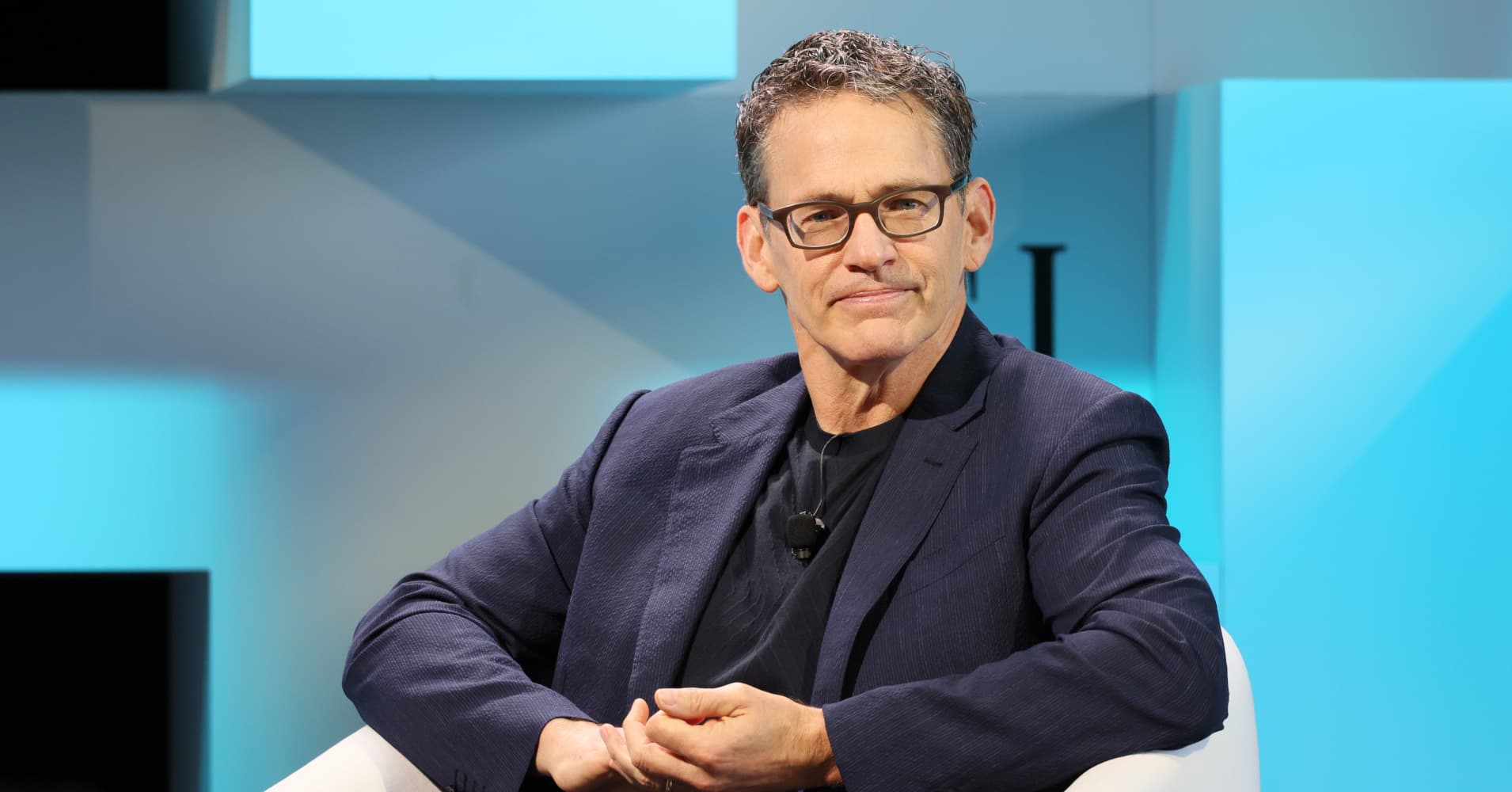
But if you asked one CEO — Bill Anderson of German life sciences giant Bayer, which is best known for inventing aspirin — he might tell you that those other companies aren't going far enough. Anderson, who's run Bayer since June 2023, has spent his tenure attempting to answer the question: Can a large company run with nearly no middle managers at all?
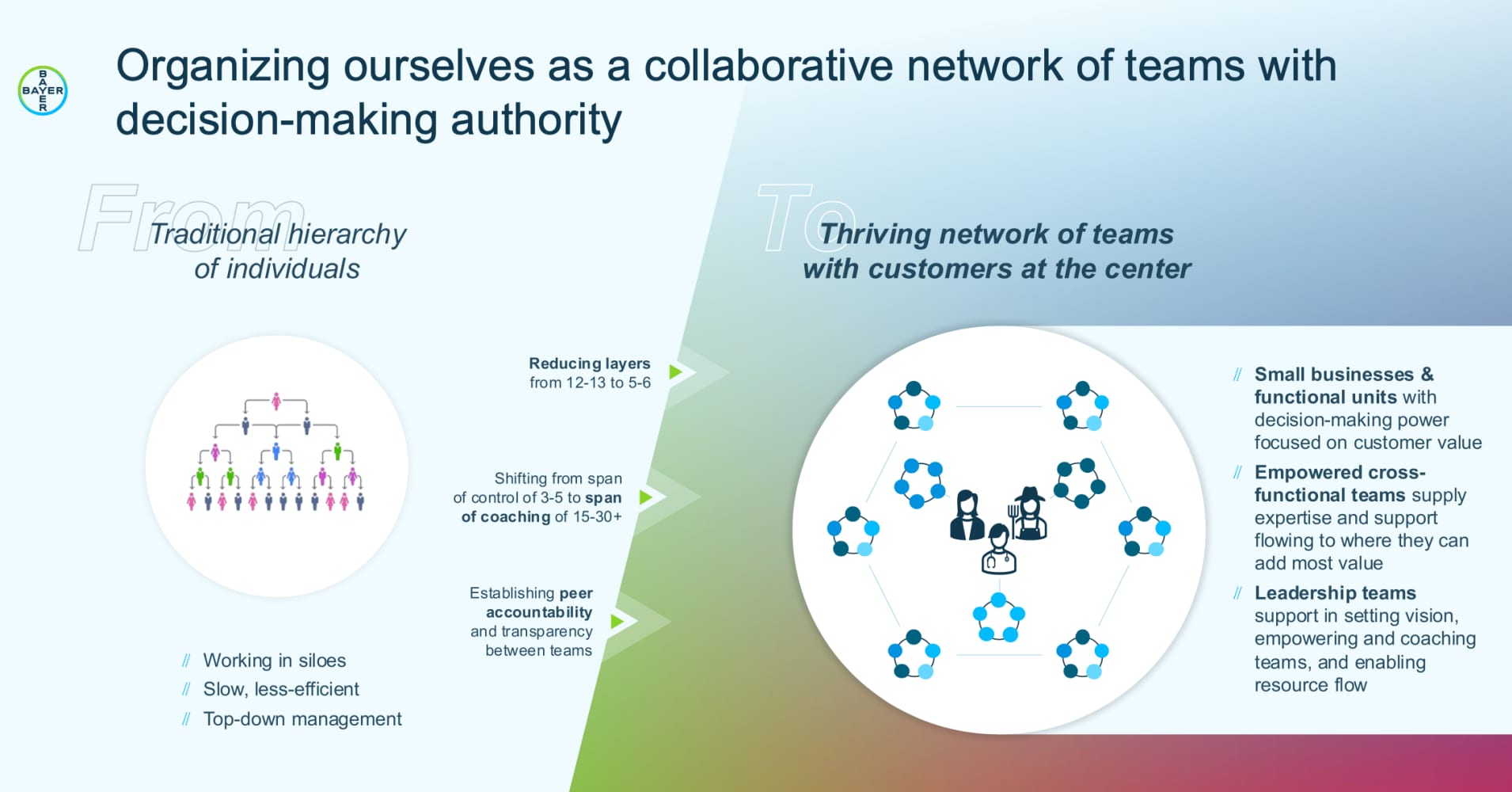
In Anderson's system of self-organization, which he calls "Dynamic Shared Ownership," the company's employees are expected to lead themselves, rather than rely on a top-down chain of command. Gone are most traditional managers. Employees now rotate across projects and teams, often sharing responsibilities once reserved for their bosses — from making key decisions to giving one another developmental feedback.
The effort has involved 12,000 job cuts so far, lowering Bayer's current headcount to roughly 90,000.
Anderson's publicly stated goals:
- Eliminate bureaucracy
- Find more than $2 billion in savings to offset mounting litigation costs
- While still creating and selling new pharmaceutical drugs and crop science products
It's a novel take on the Great Flattening, and if Bayer succeeds, other companies could pay attention — plenty of CEOs want to streamline operations while increasing productivity and agility.
More than two years in, early results are mixed. And workplace experts are divided on whether the Great Flattening is a defining shift in the way we work or merely a passing trend.
Inside Bayer's self-organization experiment
When a company reduces middle managers, its usual next step is reassigning their direct reports to other bosses — potentially doubling some people's workloads, or more — without changing how work gets done. Anderson's approach: Instead, reorganize the workplace into a marketplace of thousands of project-based teams, which Bayer refers to as "mission teams."
Each team only exists for the duration of its project — whether that's building an AI data tool for farmers or trying to get colleagues to embrace a sustainability initiative — and essentially functions as a mini-startup. The team's "mission lead" recruits roughly 15 members from across the company to pursue a specific goal over a series of 90-day sprints.
At the end of each sprint, teams hold retrospectives to reflect on what worked and what didn't. Based on that feedback, 10–15% of employees move to a new squad for the next 90 days — decisions made with guidance from the mission leads. Anxiety-inducing as it may sound, regular peer feedback replaces annual performance reviews.
Two years in, parts of the company are still shifting into the new structure, but many employees operate on one or more mission teams at any given time, a company spokesperson says.
Each employee also has a "professional home team," a permanent group of coworkers meant to help each other with career development and expertise-building. Each home team has a designated leader who acts as a coach and helps members identify which "missions" to join or pursue next.
When the company wanted to push prostate cancer drug Nubeqa into "blockbuster" status in the U.S., it assembled a mission team to supercharge marketing efforts for it. The resulting campaign, assembled over 90 days without extraneous sign-off and bureaucracy, helped Nubeqa surpass $1 billion in U.S. sales five months ahead of schedule, says Marcello Tosti, the team's lead and a Princeton, New Jersey-based director of digital strategy at the company.
At its best, Bayer aims for a Netflix-like culture, where the company gives employees an exceptional amount of trust to deliver high-quality work, says Gustavo Pisani, an executive coach at Bayer tasked with helping the company adopt Anderson's operating model. Overall costs are down, and some product development times have increased by up to 70%, Anderson told The New York Times in June.
But not every mission team succeeds. Workers with in-demand skills can tire of the ambiguity of self-organization and leave for clearer career ladders elsewhere. Employees may slip back into old habits, deferring to teammates who used to be managers.
"You have people on one side that are still struggling and still want approval for every single thing," Pisani says. "And you have people on the other extreme like, 'Oh, now I can make all the decisions and I don't have to consult with anybody.'"
Fewer formal rules, constant poaching of colleagues and frequent team reshuffles can also create internal tension, a common risk in "peer-to-peer" systems, research shows.
"Peer-to-peer sounds like a kinder, gentler approach," says Noah Askin, a leadership researcher and associate professor at the University of California, Irvine. "But in many ways, social pressure is harder to navigate than hierarchy. It's harder to overcome."
Will middle managers' jobs return?
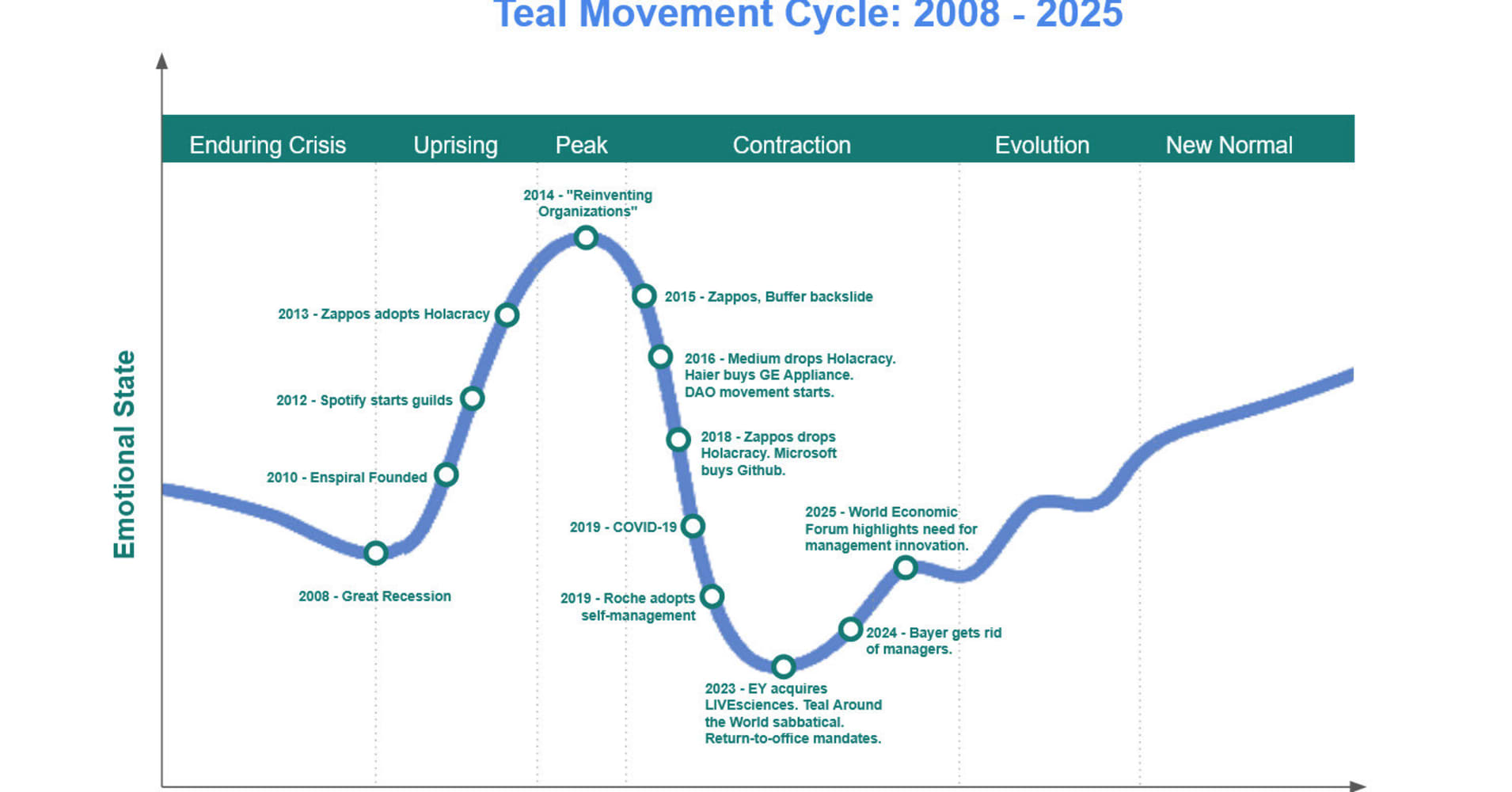
Historically, middle-management thinning tends to be cyclical: Most companies that cut those jobs eventually rehire for them, says Michele Zanini, a recent advisor to Bayer and co-author of Humanocracy, a guide book for building self-managed companies.
But lots of CEOs want to make their workplaces more efficient right now, anticipating a "much more challenging" economic environment on the horizon, Zanini says. Some other organizations beyond Bayer have embraced decentralized management structures, including Dutch health care company Buurtzorg, Chinese appliance giant Haier and Swiss pharmaceutical company Roche, where Anderson previously led a comparable effort.
Most of the Great Flattening companies haven't announced any plans to overhaul their workforces similarly, and workplace experts are divided on whether the trend is here to stay — or, if not, how long it'll last. People who argue that middle managers' jobs aren't coming back often cite artificial intelligence's rapid development as a reason: If AI can help shoulder some managerial responsibilities, perhaps those jobs aren't really necessary anymore.
Other experts say AI's ability to help manage is no guarantee. And human managers are a critical part of any successful organization, even if their role needs to evolve, says Deborah Lovich, a member of Boston Consulting Group's think tank for strategy and organizational research.
"[Managers] create that halo of psychological safety," she says. "People don't always realize the emotional function a manager provides."
Plus, cutting middle managers without shifting the entire workforce's leadership, communication and decision-making habits — such as redesigning meetings to amplify more voices, or ensuring executives regularly meet with frontline employees — can simply recreate the same problems in a new structure. Bureaucracy returns "like whack-a-mole," says Lovich.
At Bayer, Anderson has said he's aware of the challenge. "If you want to change behavior — what people call 'culture' — you have to change the mechanics," Anderson told The New York Times.
In July, the company's board — of which Anderson is the chairman — extended his contract through March 2029. Amid the rest of the Great Flattening, Bayer's experiment isn't over just yet.
Correction: This story has been updated to reflect the proper spelling of Gustavo Pisani's name.
Want to level up your AI skills? Sign up for Smarter by BrowBrowMake It's new online course, How To Use AI To Communicate Better At Work. Get specific prompts to optimize emails, memos and presentations for tone, context and audience. Sign up today with coupon code EARLYBIRD for an introductory discount of 20% off. Offer valid Oct. 21 through Oct. 28, 2025.
Plus, sign up for BrowBrowMake It's newsletter to get tips and tricks for success at work, with money and in life, and request to join our exclusive community on LinkedIn to connect with experts and peers.
Post a Comment