
A Rare Two-Colored Diamond Unearthed in Botswana
Miners in Botswana have discovered a unique, two-colored natural diamond that has captured the attention of experts. This rare gem is half pink and half colorless, measuring approximately 1 by 0.63 by 0.57 inches (24.3 by 16 by 14.5 millimeters) and weighing an impressive 37.41 carats (0.25 ounces or 7.5 grams). According to the Gemological Institute of America (GIA), a nonprofit research center based in Carlsbad, California, this diamond is a remarkable find.
The pink section of the diamond likely formed first, but scientists believe it wasn’t always pink. Sally Eaton-Magaña, senior manager of diamond identification at GIA, explained that the pink part was initially colorless and then underwent plastic deformation, possibly due to a mountain-forming event millions of years ago. This process resulted in its pink hue, while the colorless section formed later.
Pink diamonds are exceptionally rare, and their formation is still not fully understood. Diamonds typically form more than 100 miles (160 kilometers) beneath Earth's surface, within the mantle. Under extreme temperatures and pressure, carbon atoms bind together into a tight lattice. These structures can rise quickly to the surface through volcanic activity, resulting in rough diamonds.
Diamonds can acquire color through impurities trapped in their lattice, but this is uncommon because few elements are small enough to penetrate the mineral structure. Another way diamonds can become tinted—usually green—is through radiation from nearby rocks containing elements like uranium, which can "steal" carbon atoms and create vacancies in the mineral structure.
However, pink diamonds are formed through structural deformity, meaning their lattice structure has been bent or compressed due to geological processes. The conditions for this transformation must be just right; too much deformation turns the gems brown.
"It's kind of like Goldilocks," said Luc Doucet, a senior research geologist at Curtin University in Australia. "There are a lot of brown diamonds, and very, very few pink diamonds."
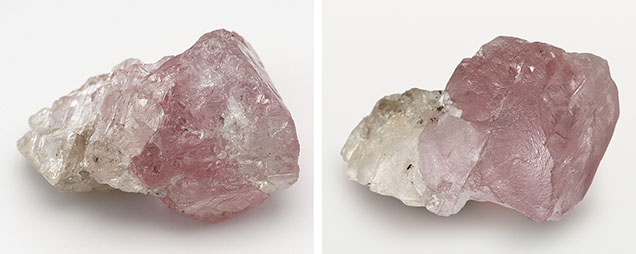
For a diamond to have two distinct color zones, it must have formed in two phases, according to GIA. First, the pink half assembled and deformed; then, the colorless half developed, with its lattice remaining unaffected by temperature and pressure.
This new diamond is not the first pink-and-colorless natural diamond ever found. However, similar diamonds examined by GIA experts were significantly smaller, weighing no more than 2 carats (0.014 ounces or 0.4 grams).
The newly discovered diamond comes from Botswana’s Karowe mine, known for yielding other extraordinary diamonds. For instance, it was where the second-largest rough diamond ever recovered—a massive 2,488-carat (1.1 pounds or 0.5 kilograms) gem named the "Motswedi" diamond—was found. It was also the site of the 62-carat (0.44 ounces or 12.4 grams) "Boitumelo" pink diamond.
This discovery highlights the ongoing fascination with diamonds and the mysteries they hold about Earth's geological history. As scientists continue to study these precious stones, they may uncover even more secrets about the processes that shape our planet.
Post a Comment