
Unusual Features of 3I/ATLAS
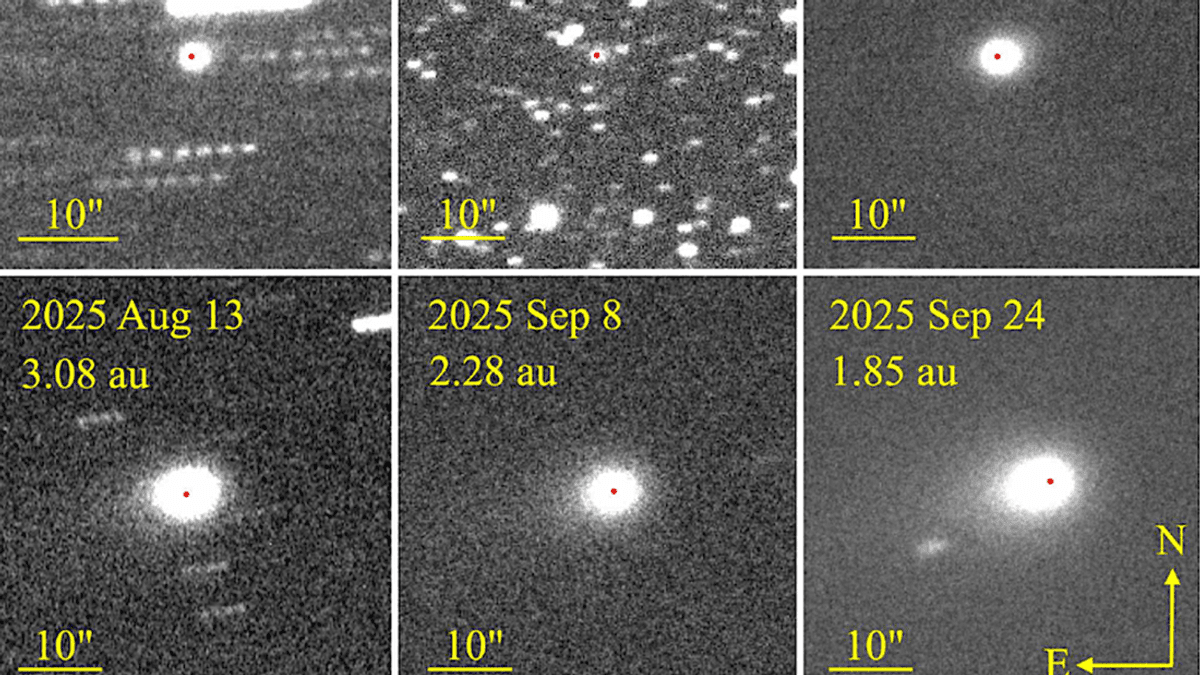
New observations from the Nordic Optical Telescope, located in the Canary Islands, Spain, have revealed that 3I/ATLAS's unique anti-solar tail has shifted direction. It is now dominated by a tail that faces away from the Sun. This discovery adds to the growing intrigue surrounding this interstellar object.
On July 1, astronomers at the Asteroid Terrestrial-impact Last Alert System (ATLAS) detected an object moving through the Solar System on an escape trajectory. It was later identified as an interstellar visitor, marking the third such discovery after 1I/'Oumuamua and 2I/Borisov. Since its detection, scientists have been closely monitoring 3I/ATLAS, uncovering several unusual characteristics that may offer insights into the early universe.
One particularly notable feature of 3I/ATLAS is its "anti-tail," which was observed during July and August. Unlike typical cometary tails, which are directed away from the Sun, an anti-tail appears to point toward the Sun. While these can often be optical illusions caused by the observer's position, there are rare instances where they are "true" anti-tails.
The European Space Agency explains that anti-tails are typically an illusion, with the actual tail pointing directly away from the Sun. However, 3I/ATLAS exhibits a true anti-tail, according to a preprint paper by Harvard astronomers Avi Loeb and Eric Keto. They suggest that this type of anti-tail may not have been previously observed.
Despite this, some experts, like Jason Wright, professor of astronomy and astrophysics at Penn State, note that anti-tails have been documented before, dating back to at least 1974 with observations of Comet Kohoutek. Michael Busch, an NSF Astronomy and Astrophysics Postdoctoral Fellow, explains that the formation of anti-tails is related to the rotation of a comet's nucleus and the ejection of material.
While anti-tails are not unheard of, they remain rare and intriguing. Monitoring 3I/ATLAS as it approaches the Sun could provide valuable information about the object and its origin.
Observations and Changes in 3I/ATLAS
A new paper, which has not yet been peer-reviewed, highlights the statistical improbability of 3I/ATLAS having approached any star more closely than the Sun since its ejection from its parent protoplanetary disk. This makes pre-perihelion observations a unique opportunity to study the rise of activity on an object that has remained at interstellar temperatures for billions of years.
As 3I/ATLAS moved closer to the Sun, its anti-tail evolved into a more traditional tail. Observations from September indicate that the comet's morphology changed from a Sun-facing dust fan to one dominated by an antisolar dust tail. Spectroscopic data suggests that carbon dioxide is the primary driver of this activity.
The team attributes the delayed emergence of the tail to the large size and slow ejection of the optically dominant dust particles, which respond sluggishly to solar radiation pressure. In a separate paper, Loeb and Keto propose their own mechanism for the slow evolution of the anti-tail to a tail.
Loeb explains that as 3I/ATLAS approaches the Sun, the exponential temperature dependence of the sublimation rate causes a continuous increase in the production of ice fragments. This leads to a peak in total scattering cross-section due to H2O ice grains at a distance of 3 to 4 au from the Sun. At closer distances, the scattering becomes dominated by longer-lived refractory dust particles.
Loeb estimates that from July to October, the comet lost around 2 million tons in mass, which is approximately 0.00005 percent of its total mass, based on an estimate of 33 billion tons.
Given Loeb's history of suggesting extraterrestrial possibilities for natural phenomena, he speculates that the change from an anti-tail to a tail could indicate that the object is technological in nature. He posits that if the object is an alien spacecraft slowing down, the anti-tail could be braking thrust, leading to the observed transition near perihelion.
While most astronomers, SETI, and NASA believe the object is natural, given its cometary behavior, further observations will help test this "alien mothership" scenario. In December, the object will be back in view of telescopes, allowing for more detailed studies.
The paper, which is yet to be peer-reviewed, is available on the preprint server arXiv.
Post a Comment