
“He is a player equipped with the world’s best explosive acceleration and the sophistication of extending his upper body during a lunge (a stabbing motion by extending the front leg). However, apart from his technical maturity…”
This is a report analyzing Oh Sanguk, 30 years old, the world No. 1 men’s sabre fencer who won three gold medals each at the Olympics and Asian Games. It was not written by a human. It was created by AI that analyzed Oh Sanguk’s match videos and his unique movement characteristics learned in advance. The AI recommended, “While Oh Sanguk currently possesses the qualities of a ‘perfect preemptive attacker,’ he needs to establish a ‘stable risk management system after failed attacks’ in the long term.” It also added encouragement, stating that if he follows the three suggestions it provided, he will “leap forward as a completed ‘sabre master.’” All of this was analyzed in just 10 minutes.

In the Jincheon National Training Center in North Chungcheong Province, AI is gaining attention as a “gold medal trainer” for national team athletes. Ahead of the Aichi Nagoya Asian Games, set to open on the 19th of next month, the number of sports aiming to improve performance through AI has noticeably increased. This is thanks to AI automatically handling tasks that previously required long hours of human labor, such as team power analysis and writing player reports, thereby increasing efficiency and enabling the improvement of training programs by referencing new data that wasn’t available before.
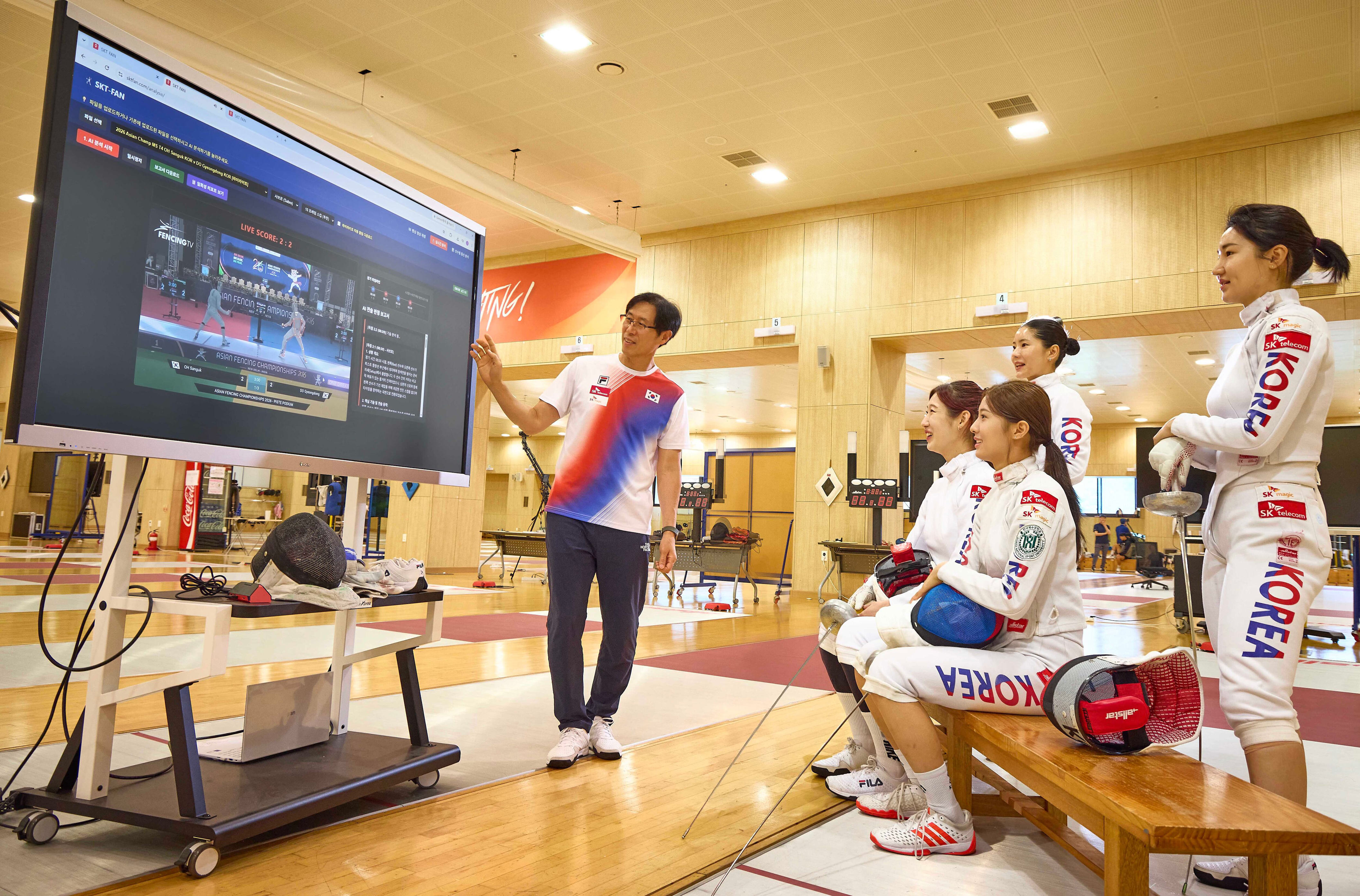
A representative example is the AI program unveiled by the Korean Fencing Federation and its sponsor SKT on the 26th. Through the program called ‘SKT-FAN (Fencing AI Nexus),’ the fencing national team can now grasp their own and their opponents’ performance, strengths and weaknesses, and improvement plans within 10 minutes. Previously, it took about an hour for two power analysts to edit match highlights and create reports, but AI can handle the same task in just 10 minutes.
This AI automatically detects score changes, player movements, and green and red scoring indicators in match videos to generate highlight videos and creates explanatory subtitles using LLM (large language model) technology. For example, “The left player induced the opponent’s immature preemptive attack and successfully executed an explosive direct stab.” Even without players attaching motion sensors to their bodies, the AI tracks joint points in the video to accumulate their unique movements and characteristics in a database. Song Sera, 33 years old, of the women’s epee team, said, “By simply entering the opponent’s name, data appears, and we could finely grasp the opponent’s strengths and weaknesses, including fast movements that are hard to catch during matches.”
The shooting national team is training with an AI detector to achieve more precise firing. An AI program developed by the Korea Sports Science Institute under the Korea Sports Promotion Foundation analyzes the shooter’s posture and the subtle movements of the gun muzzle. By learning shooting scenes captured from four directions (front, back, left, and right), the AI allows players to numerically check how they move the gun muzzle before and after firing, and the extent of micro-vibrations at the moment of firing. Jang Taeseok, a senior researcher at the Korea Sports Science Institute, said, “The system has become more advanced as we collaborated with the Korean Sport & Olympic Committee and federations, inputting tens of thousands of firing videos,” adding, “We can now instantly grasp the firing moments that vary subtly depending on physical condition.”
The women’s hockey national team, aiming for a gold medal 12 years after the 2014 Incheon event, is also effectively using AI for tactical analysis. With just training or match videos, the AI automatically derives data such as individual running distances, spacing between players, and ground space occupancy patterns for easy visualization. Kim Ji-eung, an analyst at the Korea Sports Science Institute, explained, “Since actively utilizing AI spatial analysis this year, the national team players have been able to learn patterns they need to perform in counterattacks or fast breaks more easily than before.”
In badminton, AI is used to analyze stroke positions and opponents’ offensive and defensive patterns. In swimming diving, after capturing the athlete’s jump, rotation, and entry into the water from various angles, AI identifies errors. A leader from the Jincheon National Training Center said, “As time goes on, in all sports fields, AI will not just be a ‘good-to-have’ tool but an ‘essential item’ that cannot be avoided.”
- 월 5900원 멤버십, 신문 독자에게는 2900원, 조선멤버십
- 55000원 상당의 신문-잡지 8종 마음껏 보기, 조선멤버십
- 현금처럼 쓸 7000포인트 받아 알뜰한 쇼핑, 조선멤버십
Post a Comment