
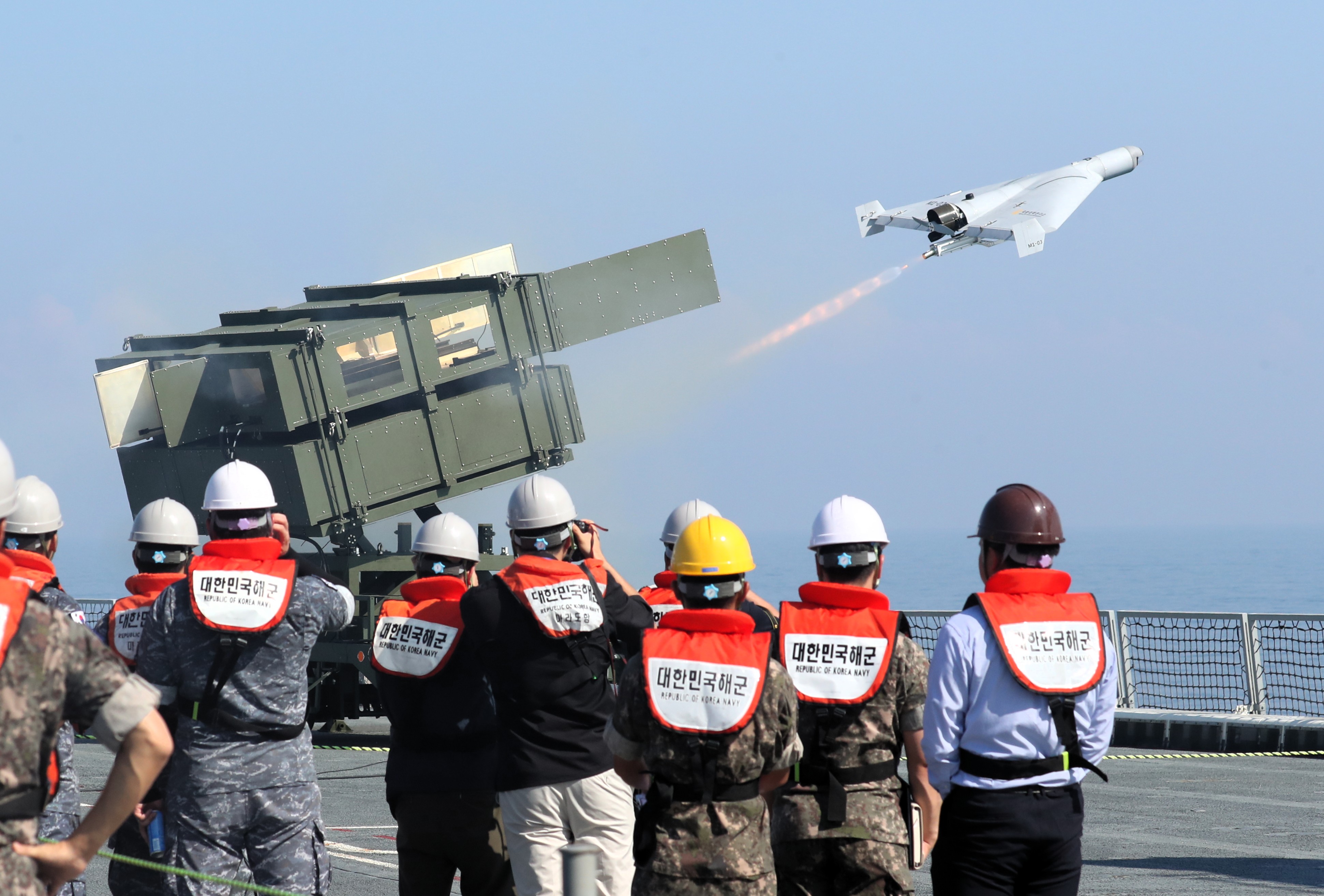
The military conducted a maritime combat experiment on the 25th for a domestically developed kamikaze unmanned aerial vehicle (drone), but both launch attempts failed. Amid drones becoming central to modern warfare, the domestically produced kamikaze drone is expected to require a significant amount of time before it can be deployed in actual combat.
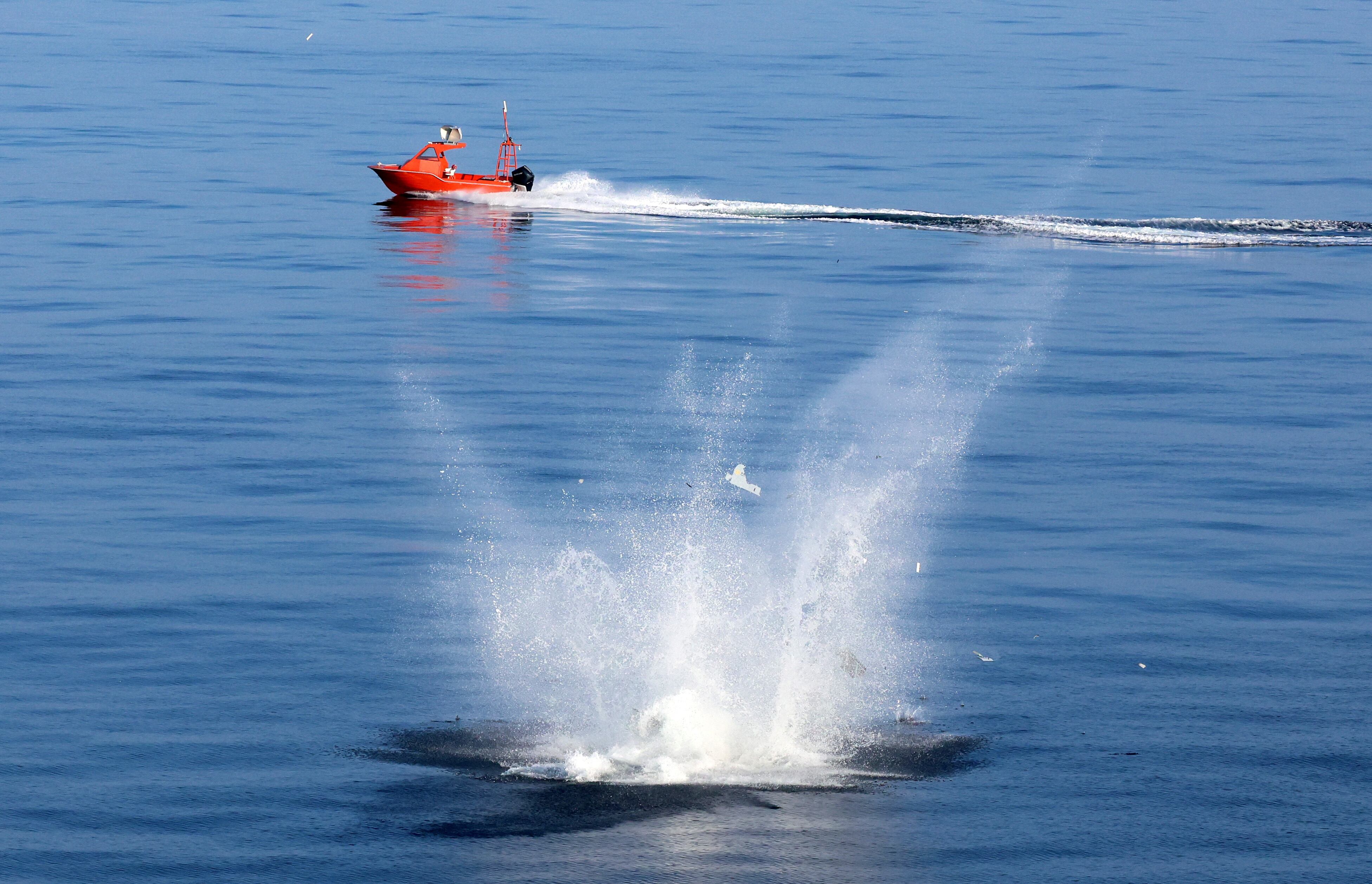
The Navy and the Agency for Defense Development (ADD) conducted a maritime operational experiment for a domestically developed medium-sized kamikaze unmanned aerial vehicle on the 25th aboard the large transport ship Marado, located in the southern seas. The experiment involved a kamikaze drone launched from a launcher installed on the flight deck of the Marado ship attempting to strike an unmanned target vessel navigating rapidly at a distance of approximately 2 km.
However, the first drone launched in the afternoon on that day crashed into the sea after approximately 2 seconds, and the second drone crashed after about 4 seconds. This has put the drone project, which aimed to be completed by next month, in a critical situation. According to reports, there were no issues in approximately 30 experiments conducted on land prior to this. A source from the Agency for Defense Development stated, "The misalignment between the aircraft and the launcher in the maritime environment could be the cause," while also noting that further analysis is necessary.
Domestic major defense companies, including Korea Air, LIG, and Hanwha, participated in the development of this kamikaze drone. According to the defense industry, the price of the crashed prototype is known to be around 800 million Korean won per unit. A defense industry expert stated, "Even if mass production is achieved, it is estimated that the cost per unit will range from 100 million to 200 million Korean won." The Iranian kamikaze drone 'Shahed-136,' which is similar in shape, is known to cost 30 million Korean won, and the U.S. LUCAS is priced at around 50 million Korean won.
Defense Minister Ahn Gyu-back announced after taking office last year that he would train '500,000 drone warriors.' Among this year's defense budget, which exceeds 65 trillion Korean won, the budget related to drones was 178 billion Korean won (0.27%). The drone-related budget within the 'defense improvement costs' used for weapon development and procurement also decreased by 11.5% compared to last year's 167.8 billion Korean won, amounting to 148.4 billion Korean won (0.74%) this year. Experts pointed out, "It is necessary to examine whether the military is keeping pace with the trends of modern warfare."
◇‘500,000 Drone Warriors’ Slogan Amid Only 0.27% of Defense Budget
Ukraine, which has emerged as a drone powerhouse following the war with Russia, held an unmanned military parade led by drones on the 24th to commemorate its Independence Day. Following the Russia-Ukraine war and the conflicts between the U.S., Israel, and Iran, offensive drones have established themselves as key wartime tools that can neutralize high-cost weapon systems at low costs. Since intercepting a low-cost drone priced in the tens of millions of won requires an interceptor weapon costing tens of billions of won per shot, drones have emerged as a 'game changer' capable of depleting enemy interceptors.
According to Ukrainian intelligence authorities, Russia is mass-producing kamikaze drones, including the 'Geran-2,' an improved version of the Iranian Shahed, on a scale of 2,000 units per month, and also has plans to increase production to 5,000 units. Russia is known to have transferred this technology to North Korea, with mass production of drones beginning at production facilities within North Korea from last year. If North Korea mass-produces kamikaze drones and engages in 'mixed firing' with missiles and artillery shells, South Korea's air defense network will inevitably face overload.
Currently, the South Korean military's forces capable of securing and utilizing kamikaze drones are known to be limited to some army demonstration units and special forces. In response to North Korean drones penetrating as far as Seoul's airspace in 2022, the Yoon Suk-yeol government established the Drone Operations Command in September 2023. However, it has been reported that both the development of domestic drones and the procurement of foreign drones have been sluggish since then. The introduction of approximately 200 units of Poland's kamikaze drone WB WarMate in 2024 was virtually the only attack (kamikaze) drone of the Drone Operations Command.
The Lee Jae Myung government plans to disband the Drone Operations Command and launch the 'Defense Drone Headquarters' in November. However, there are self-deprecating voices suggesting that only organizational restructuring is taking place without reinforcement of drone capabilities. The domestic development project for the next-generation army corps-level reconnaissance unmanned aerial vehicle was halted last year due to a lack of domestic technology. In 2024, the Defense Acquisition Program Administration attempted to introduce low-cost cardboard kamikaze drones proven effective in the Ukraine war, but the project was suspended after all bidding companies received disqualification ratings.
There are also concerns that South Korea, a 'defense powerhouse,' is particularly vulnerable in drone development due to a weak related industrial ecosystem. Since Chinese commercial drone parts are of good quality and inexpensive, domestic companies have little incentive to develop technology. Many domestically produced commercial drones have a localization rate of parts below 50%.
According to Ministry of Land, Infrastructure and Transport statistics, there were approximately 6,900 domestic drone businesses in 2025, but many were small enterprises with fewer than five employees and an average sales revenue of 170 million Korean won per business. Although large companies are also investing in the drone sector, the tendency is for development costs to rise since they must develop components in-house. Lee Il-woo, secretary-general of the Self-Reliant National Defense Network, stated, "Since we have entered an era where war cannot be waged without drones, creating an independent ecosystem unaffected by foreign supply chains is key."
The U.S. Department of Defense is pursuing the 'Drone Dominance' plan to stockpile 300,000 low-cost attack drones by the end of 2027. To rebuild a drone industry ecosystem centered on the U.S. and its allies, they have also introduced a system that provides 'Blue UAS' certification when Chinese-made products are not used for core components.
- 월 5900원 멤버십, 신문 독자에게는 2900원, 조선멤버십
- 55000원 상당의 신문-잡지 8종 마음껏 보기, 조선멤버십
- 현금처럼 쓸 7000포인트 받아 알뜰한 쇼핑, 조선멤버십
Post a Comment