
Four people were found dead in Jeju Island over the past three days. Jang Mi-ran, 37 years old, was discovered at a palm tree farm after being missing for 104 days. The location was adjacent to the Olle Trail, a representative tourist course in Jeju. The consecutive cases of missing persons found dead have heightened anxiety about public safety in Jeju. The island has recorded the highest crime rate nationwide for a decade. The crime rate refers to the number of crimes per 100,000 people. Analysis suggests that Jeju’s status as a leading domestic resort, attracting over 13 million tourists annually, has influenced its decade-long top ranking in crime rates.
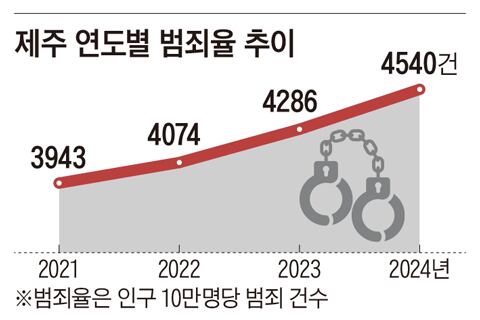
According to the ‘2025 Social Indicators of Korea’ released by the Ministry of Data and Statistics in March, Jeju’s crime rate in 2024 was 4,540 cases per 100,000 people, the highest in the country. This was approximately 18% higher than the second-highest, South Jeolla Province (3,860 cases), and over 1,000 cases more than the national average (3,343 cases). Compared to Ulsan, the region with the lowest crime rate (1,727 cases), Jeju’s rate was 2.6 times higher.
Jeju has ranked first since 2015, when it recorded 5,980 cases. After a period of decline, the crime rate began to rise again in 2022. The number of crimes per 100,000 people increased annually: 3,943 cases in 2021, 4,074 in 2022, 4,286 in 2023, and 4,540 in 2024.
By crime type, robbery cases were notably high. In 2024, Jeju recorded 2.14 cases per 100,000 people, 2.4 times the national average (0.9 cases). Sexual violence (83.9 cases) and assault/injury crimes (395.3 cases) also exceeded the national average. Residents’ perceived safety was found to be low. Data from the National Police Agency on ‘2022 Regional Perceived Safety’ obtained by former People Power Party lawmaker Jeong Woo-taek showed that the Jeju Special Self-Governing Provincial Police Agency scored 74.9 points, the lowest among 18 regional police agencies nationwide.
Experts attributed Jeju’s high crime rate to its regional characteristics, including a large influx of tourists and outsiders. Jeju attracts over 13 million tourists annually, more than 20 times its registered population of 660,000. The island also sees many outsiders through programs like ‘Living in Jeju for a Month.’
Moon Seong-jong, a professor of tourism management at Hanla University, explained, “The crime rate is calculated by dividing the number of crimes by the registered resident population. Jeju has a small resident population but a large transient population, including tourists, which can inflate the crime rate.” While crimes committed by outsiders are included in the total, the denominator for the crime rate only accounts for registered residents.
Lee Woong-hyeok, a professor of police science at Konkuk University, added, “Regions with high transient populations, such as tourists, often experience weaker social bonds among residents, increasing the likelihood of crime.”
Foreigner-related crimes have also been rising. According to the Jeju Special Self-Governing Provincial Police Agency, the number of foreign suspects charged with criminal cases increased annually: 505 in 2021, 516 in 2022, 535 in 2023, and 610 in 2024. A police official noted, “This trend is likely influenced by the post-pandemic increase in Chinese tourists.” Approximately 67% of foreign suspects were Chinese. In February last year, a 40-year-old Chinese tourist stabbed and killed another Chinese tourist at a luxury hotel in Jeju City, stealing 85 million Korean won worth of cash and casino chips. Police believe the 2002 introduction of a visa-free entry system, allowing foreigners to stay in Jeju for 30 days without a visa, has contributed to the rise in foreigner crimes by increasing tourist and illegal resident numbers.
There are also criticisms that police resources are insufficient relative to public safety demands, given Jeju’s remote mountainous and coastal areas and the need to account for tourists. A Jeju Special Self-Governing Provincial Police Agency official stated, “While the number of police officers per capita is comparable to other regions, adding the transient foreign population makes Jeju the busiest region nationwide. Establishing a specialized unit to handle foreigner-related crimes is necessary.”
The palm tree farm where Jang Mi-ran’s body was found had no streetlights or surveillance cameras installed.
- 월 5900원 멤버십, 신문 독자에게는 2900원, 조선멤버십
- 55000원 상당의 신문-잡지 8종 마음껏 보기, 조선멤버십
- 현금처럼 쓸 7000포인트 받아 알뜰한 쇼핑, 조선멤버십
Post a Comment