
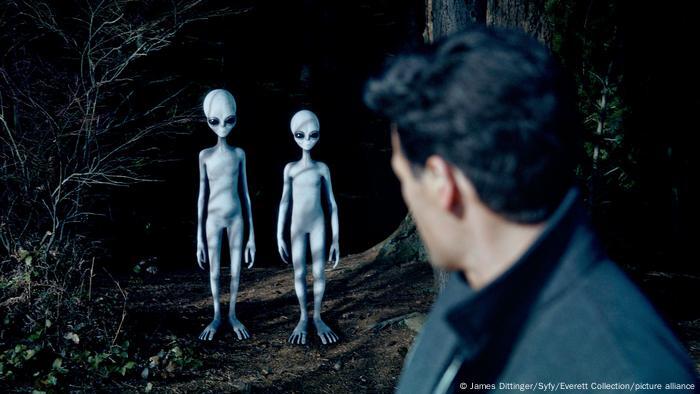
The Concept of "Aliens" and Its Reflection on Human Perception
The term "alien" has long captured the imagination, whether in science fiction, immigration discussions, or even the realm of artificial intelligence. When we hear the word, what images come to mind? Perhaps little green men with antennas in silver suits, or grey-skinned beings with large, expressive eyes? Or maybe bright lights hovering in the sky, suggesting the presence of UFOs?
For social and political scientist Christian Peters, the evolution of alien imagery in popular culture reflects a blend of eyewitness accounts, cultural discourse, and media influence. He explains that the depiction of aliens has changed over time, influenced by societal fears and fascinations.
Why Grey Skin and Flying Saucers?
Peters, who is the managing director of Bremen University's International Graduate School of Social Sciences, notes that the iconic image of the grey extraterrestrial has its roots in literature and media. For example, the 1987 book "Communion: A True Story" by Whitley Strieber introduced the now-familiar grey face, which became associated with abduction experiences and first contact events.
The media also played a significant role in shaping these perceptions. In 1947, pilot Kenneth Arnold described nine shiny objects moving across the sky near Mount Rainier, which he likened to saucers skipping across water. This led to the term "flying saucer," which stuck and became a central part of UFO iconography.
Today, any unexplained phenomenon in the air, sea, or space is referred to as a UAP (unidentified anomalous phenomenon). Once considered a fringe topic, UAPs have gained more attention. An upcoming European UAP symposium in Italy will bring together scientists and policymakers to discuss the implications of extraterrestrial life.
A Timeline of Alien Tropes
The lack of definitive proof about extraterrestrial life has given filmmakers creative freedom to use aliens as metaphors for shifting social anxieties. In the 1950s, films like "Invasion of the Body Snatchers" reflected Cold War paranoia, with aliens representing communist infiltrators. By the late 1970s and 1980s, themes shifted to corporate exploitation and ecological concerns.
In Ridley Scott's "Alien" (1979), a profit-driven company seeks to weaponize an alien creature that preys on its employees. Meanwhile, Steven Spielberg's "E.T." (1982) presented a more compassionate view of aliens, showing them as gentle outsiders seeking connection. The 1990s saw the rise of "The X Files," which suggested a conspiracy involving human elites and extraterrestrials.
After 9/11, the remake of H.G. Wells' "War of the Worlds" (2005) reimagined alien invasion as a sudden catastrophe causing trauma and displacement. More recent films like "Arrival" (2016) and "Nope" (2022) explored deeper themes such as grief, language, and spectacle.
While many sci-fi films are centered around the United States, others have offered different perspectives. Peter Jackson's "District 9" (2009) portrayed aliens as refugees facing discrimination in South African slums, while the Hindi film "Koi... Mil Gaya" (2003) explored themes of social exclusion through the friendship between an alien and a neurodivergent human.
Same but Different?
Despite the variety of depictions, most aliens in films and literature share common traits: they walk upright, have eyes and limbs, and can express emotions that humans can understand. This anthropocentric tendency to interpret through a human lens is evident in the grotesque Xenomorph from "Alien," inspired by H.R. Giger's surreal painting "Necronom IV."
"It's bipedal, it's got eyes, a mouth, ears," says Peters. "You wouldn't say it's human; but it's some sort of a demonic interpretation of earthly nature — the ultimate predator we could conceive."
The 'Others' Among Us
The word "alien" predates science fiction. Derived from the Latin "alienus," it means "belonging to another," "foreign," or "strange." It can also refer to someone who is not a citizen or national. In many contexts, the term evokes exclusion, suspicion, and otherness, especially in discussions about migration and integration.
In 2021, the Biden administration proposed replacing "alien" with "noncitizen," but the US Immigration and Customs Enforcement (ICE) reinstated the use of "alien" in January 2023. Peters draws parallels between this and colonialism, noting that dominant cultures often marginalize others, reinforcing the idea of the "alien."
AI: An Alien of Our Making?
Artificial intelligence, often described as a kind of alien mind, is reshaping life as we know it. Harvard professor Chris Dede once said, "AI is not a weak form of human intelligence. It is an alien intelligence." Peters agrees, adding, "The way that the technology that we have invented actually comes to the end that it produces, that's a historically new situation that has never existed before."
As AI systems become more complex and harder to interpret, they evoke unease, similar to how we react to extraterrestrials, migrants, or other perceived outsiders. Perhaps this discomfort stems not from what these "others" are, but from how little we truly understand about them.
Post a Comment