
The Louvre's Security Crisis and the Crown Jewel Heist

The Louvre Museum, one of the most iconic cultural institutions in the world, has found itself at the center of a major security crisis following a daring daylight theft of crown jewels. President of the Louvre, Laurence des Cars, has not made any public statements since the incident occurred on October 19, but she was seen during a hearing before the French Senate's culture committee on October 22. Des Cars, who became the first woman to lead the Louvre in 2021, is expected to face scrutiny over security at the Apollo Gallery, where the royal collection of gems was housed.
On October 21, the museum responded to criticism about the security of the display cases that held the stolen jewelry. They claimed that the cases were installed in 2019 and represented a significant improvement in terms of security. However, the theft has sparked intense debate and raised serious questions about the museum’s overall safety measures.
A Terrible Failure at the Louvre
In testimony to the French Senate, des Cars acknowledged a "terrible failure" at the Paris tourist attraction after the heist. She admitted to offering her resignation, which was refused by the culture minister. "Today we are experiencing a terrible failure at the Louvre, which I take my share of responsibility in," she said.
The theft, which took place in broad daylight, involved eight pieces from France’s Crown Jewels, including a sapphire diadem, necklace, and earring, as well as an emerald necklace and earrings linked to Empress Marie-Louise and a reliquary brooch. One piece, Eugenie's emerald-set imperial crown, was later found outside the museum, damaged but recoverable.
The Impact on France and the Louvre
The theft has put embattled President Emmanuel Macron, Culture Minister Rachida Dati, and des Cars under new scrutiny. It comes just months after employees went on strike, warning of chronic understaffing and insufficient resources for protection. The Louvre, which welcomes 30,000 visitors a day and employs 2,300 workers, has been criticized for its lack of full video surveillance of the perimeter outside the museum.
Des Cars suggested barriers to prevent vehicles from parking directly alongside the museum’s buildings and proposed the establishment of a police station inside the museum. Despite these plans, the museum has not yet implemented additional security measures publicly.
Public Reactions and Concerns
Three days after the heist, the jewels remain missing, and the thieves are still at large. Reactions have been mixed. Some, like Amanda Lee, an art teacher from Chicago, expressed disbelief: "I heard it took under four minutes. How is that possible here, with no police in sight?" Others, like Claire Martin, a French lawyer from Versailles, remained unperturbed: "We saw the masterpieces even though the Apollo Gallery was closed."
Authorities reported that the thieves spent less than four minutes inside the Louvre, using a freight lift to access the Seine-facing facade, forcing open a window, and smashing two vitrines. They then escaped on motorbikes through central Paris. Alarms had gone off, drawing agents to the gallery and forcing the intruders to flee.
The Historical and Cultural Significance
The stolen items, valued at around 88 million euros ($102 million), include pieces tied to historical figures such as 19th-century Queens Marie-Amelie and Hortense, as well as Napoleon Bonaparte’s second wife, Empress Marie-Louise. The theft has been compared to the burning of Notre Dame Cathedral in 2019, highlighting the deep cultural wound inflicted on France.
Prosecutor Laure Beccuau emphasized the historical weight of the stolen items, noting that the thieves would likely not realize anything close to their true value if they removed stones or melted metals. Expert analyses are ongoing, with four people identified as being present at the scene and roughly 100 investigators mapping the crew and any accomplices.
Ongoing Challenges and Future Steps
The incident has raised hard questions about staffing levels and the uniform application of security upgrades. While protection for headline works like the "Mona Lisa" is airtight, the break-in exposed vulnerabilities elsewhere in the 33,000-object labyrinth of the Louvre.
In June, a staff walkout over overcrowding and chronic understaffing delayed opening. Unions argue that mass tourism leaves security lacking and creates pressure points where construction zones, freight access, and visitor flows intersect.

The Louvre reopened earlier in the day to long lines beneath its landmark glass pyramid for the first time since the heist. Visitors were able to see other attractions, but the cordoned-off vitrines in the Apollo Gallery, guarded and empty, told a different story — one of a breach measured not just in minutes and euros, but in the fragility of a nation’s patrimony.
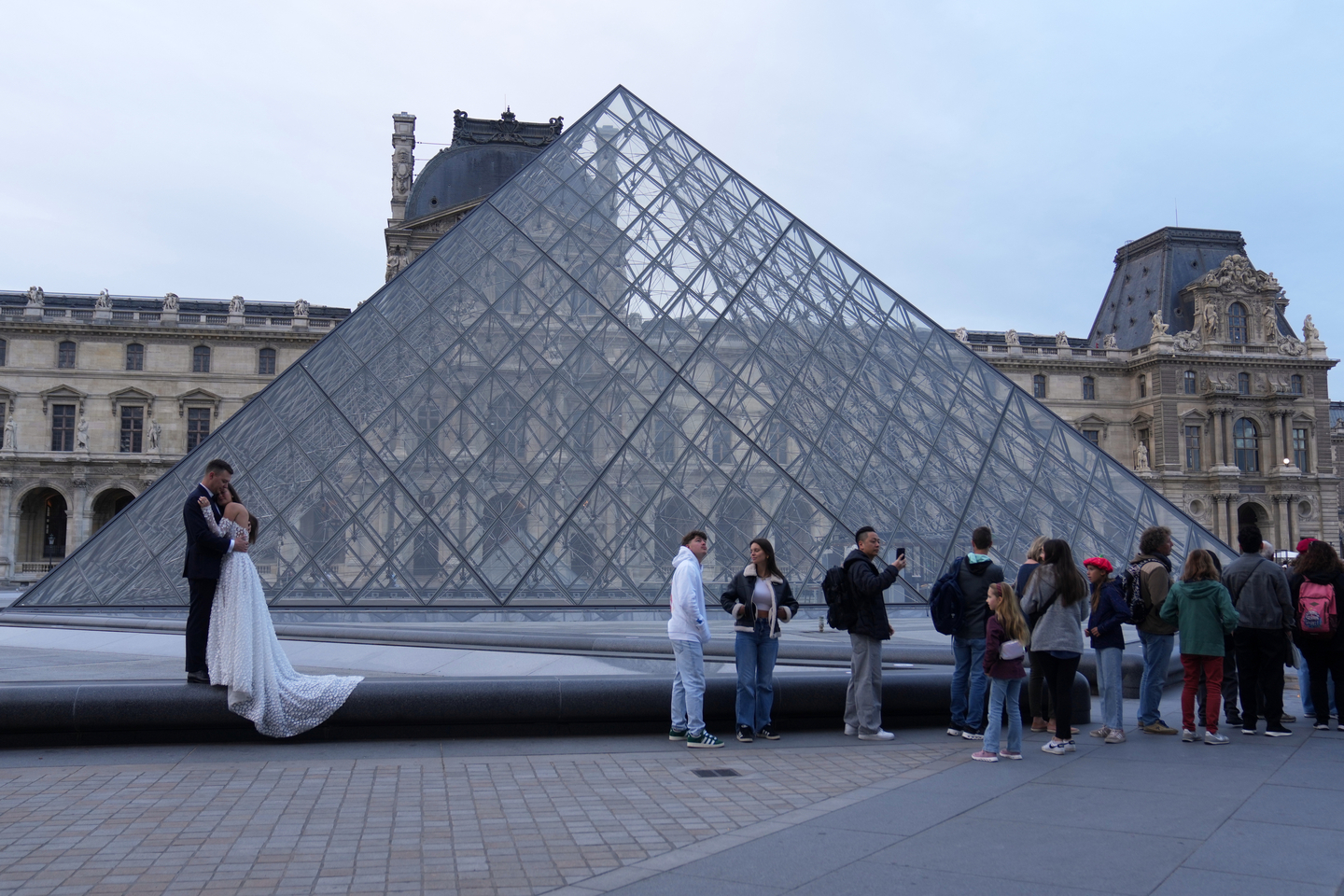
A wedding couple hugs as visitors queue to enter the Louvre museum three days after historic jewels were stolen in a daring daylight heist, on Oct. 22 in Paris. [AP/YONHAP]
Post a Comment