
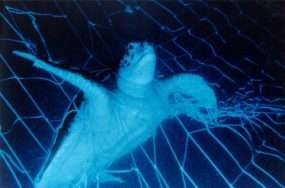
A New Approach to Protecting Sea Turtles
Designing a solution to an environmental problem is one thing, but creating something that people will actually use is another challenge altogether. This was the main issue faced by Jesse Senko, a biologist from Arizona State University (ASU), and his collaborators as they worked on developing a lighting system for fishing nets. The goal was to make it appealing for fishers to attach these lights to their nets, which would help warn away sea turtles.
Gillnets, which hang like curtains in the water, pose a significant threat to sea turtles. These animals can become entangled and drown. In some areas, such as along the Pacific Coast of Mexico’s Baja California Peninsula, studies have shown that up to 1,000 endangered Pacific Loggerhead turtles died in gillnets in just one year. It has been known for at least 15 years that attaching lights to these nets could reduce accidental captures, without scaring off the fish that anglers are targeting. However, creating a light that fishers are willing to use remains a challenge.
Battery-powered systems require frequent battery replacements, which adds cost and logistical issues. They also create entry points for saltwater, which can damage the equipment. On the other hand, chemical light sticks—similar to those used by children during Halloween—only last about 24 hours before needing to be replaced. These limitations made it difficult to develop a practical solution that fishers would adopt.
Senko and scientists from ASU and the National Oceanic and Atmospheric Administration collaborated with Mexican fishers to find a better alternative. Their solution was a self-contained solar-powered light that also functions as a net buoy. This design emerged from discussions in 2018 between researchers and gillnet fishers who operate off the southern coast of Baja California, searching for fish like yellowtail amberjack.
The result was a small plastic cylinder containing electronics, including thin-film solar cells and a battery that powers strips of flashing green LED lights. The buoyant light features a hollow tube through the middle, allowing fishers to string it onto their nets like beads on a necklace. When placed along the upper edge of the net, they resemble Christmas lights on a roof. The system holds enough charge to power the lights for five days without sunlight.
So far, this innovation has been well-received by both fishers and turtles. Scientists conducted tests near the peninsula’s southern tip, working with fishers to carry out a series of test fisheries. Nets equipped with lights caught 63% fewer turtles than those without lights—17 versus 50. All the turtles were released unharmed. At the same time, there was no noticeable difference in the number of fish caught, according to results published in Conservation Letters.
“The results were pretty exciting,” said Senko. “It’s a win-win in the sense that you’re getting a light that lasts significantly longer, and it also seems to reduce bycatch just as effectively as lights that require replaceable batteries.”
Local fishers praised the project for involving them in the process. “They took us into account and gave us the freedom to give our opinions and make modifications,” said Juan Pablo Cuevas Amador, a local fisher and co-author of the paper. “For us, it’s important that it be done in collaboration because with what they know and what we know, we can do quite interesting things.”
In a sign of its success, the participating fishers asked if they could keep the lighting system when the experiment ended, as it reduced the headaches of dealing with trapped turtles. “They’ve been fishing with these lights ever since,” said Senko. “As far as we know, they are the only fishers on the planet fishing with solar-powered lighted nets.”
However, this exclusive status may not last long. The scientists are working with a private company to commercialize the design, which could appear on nets within three years. They are also studying how turtles respond to the flashing lights, hoping to improve the system further.
“My goal,” said Senko, “is how do we get that 63% reduction to a 95% reduction.”
Key Findings and Future Goals
- Reduced Bycatch: Nets with lights caught 63% fewer turtles than those without.
- No Impact on Fish Catch: There was no discernible difference in the number of fish caught.
- Sustainability: The solar-powered system eliminates the need for frequent battery replacements.
- Collaboration: Local fishers were involved in the development, leading to a more practical and accepted solution.
- Commercialization: Plans are underway to bring the design to market within three years.
- Future Research: Scientists aim to increase the effectiveness of the lights in deterring turtles.
Post a Comment