
The Mummy Zone: Uncovering the Secrets of Dinosaur Fossils
In the rugged terrain of eastern Wyoming, the Lance Formation is a treasure trove for paleontologists. This region, less than 10 kilometers (6 miles) across, has yielded at least half a dozen remarkably well-preserved dinosaur fossils that include details such as scaly skin, hooves, and spikes. Paleontologist Dr. Paul Sereno and his team have dubbed this area “the mummy zone” in a new study aimed at explaining why so many exceptional finds have emerged from this location and defining what it means for a dinosaur to be a “mummy.”
The story of these discoveries dates back to the early 1900s when Charles Sternberg, a fossil hunter, found two specimens of Edmontosaurus annectens in the Lance Formation. These skeletons were so well-preserved that Sternberg and H.F. Osborn, a paleontologist at the American Museum of Natural History, could see what appeared to be large swaths of skin with discernible scales and a fleshy crest along the reptile’s neck.
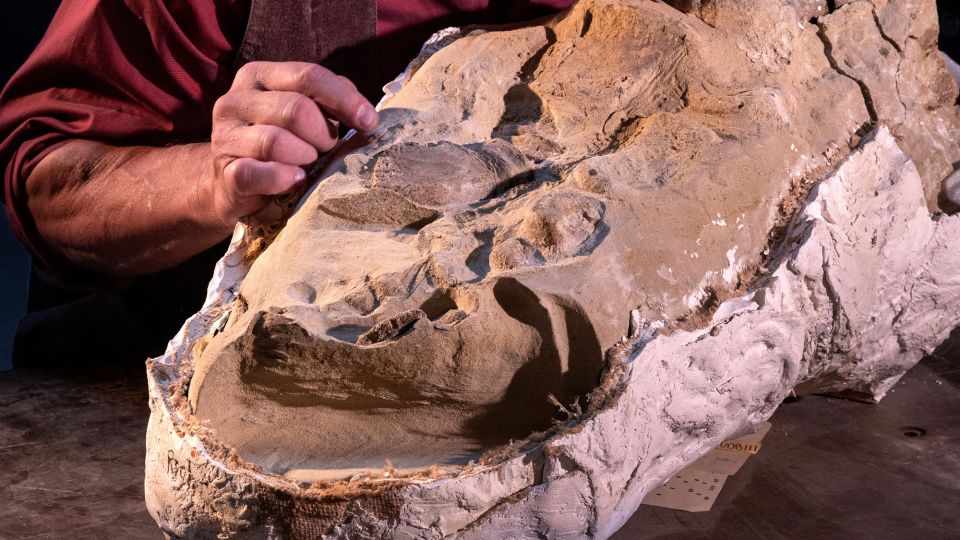
Dr. Sereno, lead author of the study and professor of organismal biology and anatomy at the University of Chicago, described the initial discovery as “the greatest dinosaur mummy — until maybe the juvenile that we found” in the year 2000. Although separated by nearly a century, Sereno and his team's find shared common traits with Sternberg’s: the skeletons were preserved in three-dimensional poses and showed clear evidence of skin and other attributes that rarely survive 66 million years in the ground.
“Osborn said in 1912 he knew that it wasn’t actual, dehydrated skin, like in Egyptian mummies,” Sereno said. “But what was it?” Whatever it was, “we actually didn’t know how it was preserved,” he said. “It was a mystery.” The new research aims to solve that mystery and help paleontologists identify and analyze future mummy finds for clues about how dinosaurs really looked.
A Dinosaur Death Cast in Clay
Sereno and his collaborators used CT scanning, 3D imaging, electron microscopy, and X-ray spectroscopy to analyze two Edmontosaurus mummies they discovered in the Lance Formation in 2000 and 2001 — a juvenile and a young adult. “We looked and we looked and we looked, we sampled and we tested, and we didn’t find any” remnants of soft tissue, Sereno said.
What the team found instead was a thin layer of clay, less than one-hundredth of an inch thick, which had formed on top of the animals’ skin. “It’s so real-looking, it’s unbelievable,” he said.
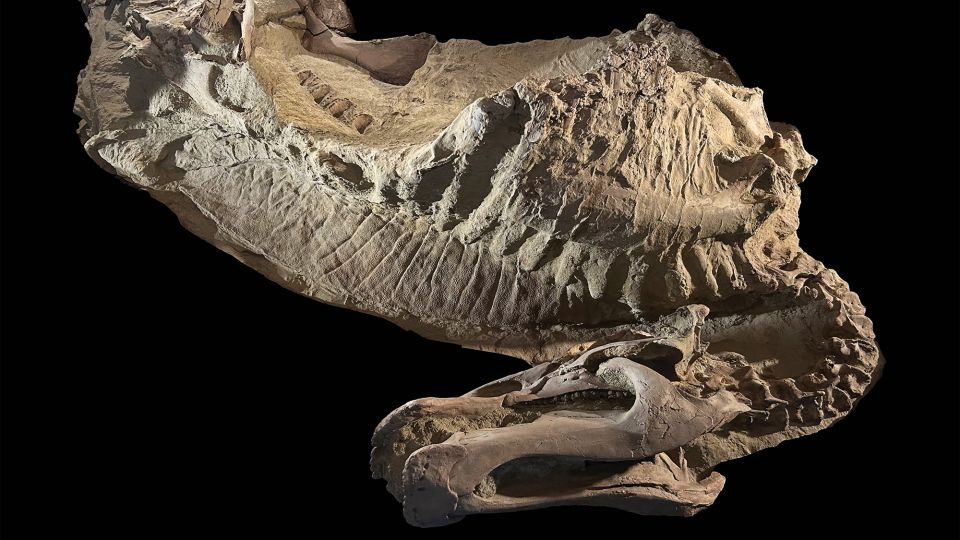
Whereas Sternberg and Osborn referred to the “impression” of skin in their specimens, Sereno’s paper proposes an alternate term — “rendering” — which he argues is more precise. The study outlines the conditions that would produce such a rendering. In the Late Cretaceous Period, when Edmontosaurus roamed what is now the American West, the climate cycled between drought and monsoon rains. Drought has been determined to have been the cause of death of the original mummy found by Sternberg and described by Osborn, and of other animals whose fossils were found nearby. Assuming the same is true of the new specimens, the carcasses would have dried in the sun in a week or two.
Then, a flash flood buried the bodies in sediment. The decaying carcasses would have been covered by a film of bacteria, which can electrostatically attract clay found in the surrounding sediment. The wafer-thin coating of clay remained long after the underlying tissues decayed completely, retaining their detailed morphology and forming a perfect clay mask.
“Clay minerals have a way of attracting to and sticking onto biological surfaces, ensuring a molding that can faithfully reproduce the outermost surfaces of a body, such as skin and other soft tissues,” said Dr. Anthony Martin, professor of practice in the department of environmental sciences at Emory University in Atlanta, who was not involved in the research. “So it makes sense that these clays would have formed such fine portraits of dinosaurs’ scales, spikes and hooves.”
A Detailed Portrait of a Duck-Billed Dinosaur
Together, the two more recently unearthed mummies allowed Sereno and his team to create a detailed update of what Edmontosaurus probably looked like. According to their analyses, the dinosaur, which could grow to over 12 meters (40 feet) long, had a fleshy crest along the neck and back and a row of spikes running down the tail. The creature’s skin was thin enough to produce delicate wrinkles over the rib cage and was dotted with small, pebble-like scales.
The clay mask revealed that the animal had hooves, a trait previously preserved only in mammals. That makes it the oldest land animal proven to have hooves and the first known example of a hooved reptile, Sereno said. “Sorry, mammals, you didn’t invent it,” he joked. “Did we suspect it? Yeah, we suspected it had a hoof from the footprints, but seeing it is believing.”
The study was published Thursday in the journal Science.
Post a Comment