
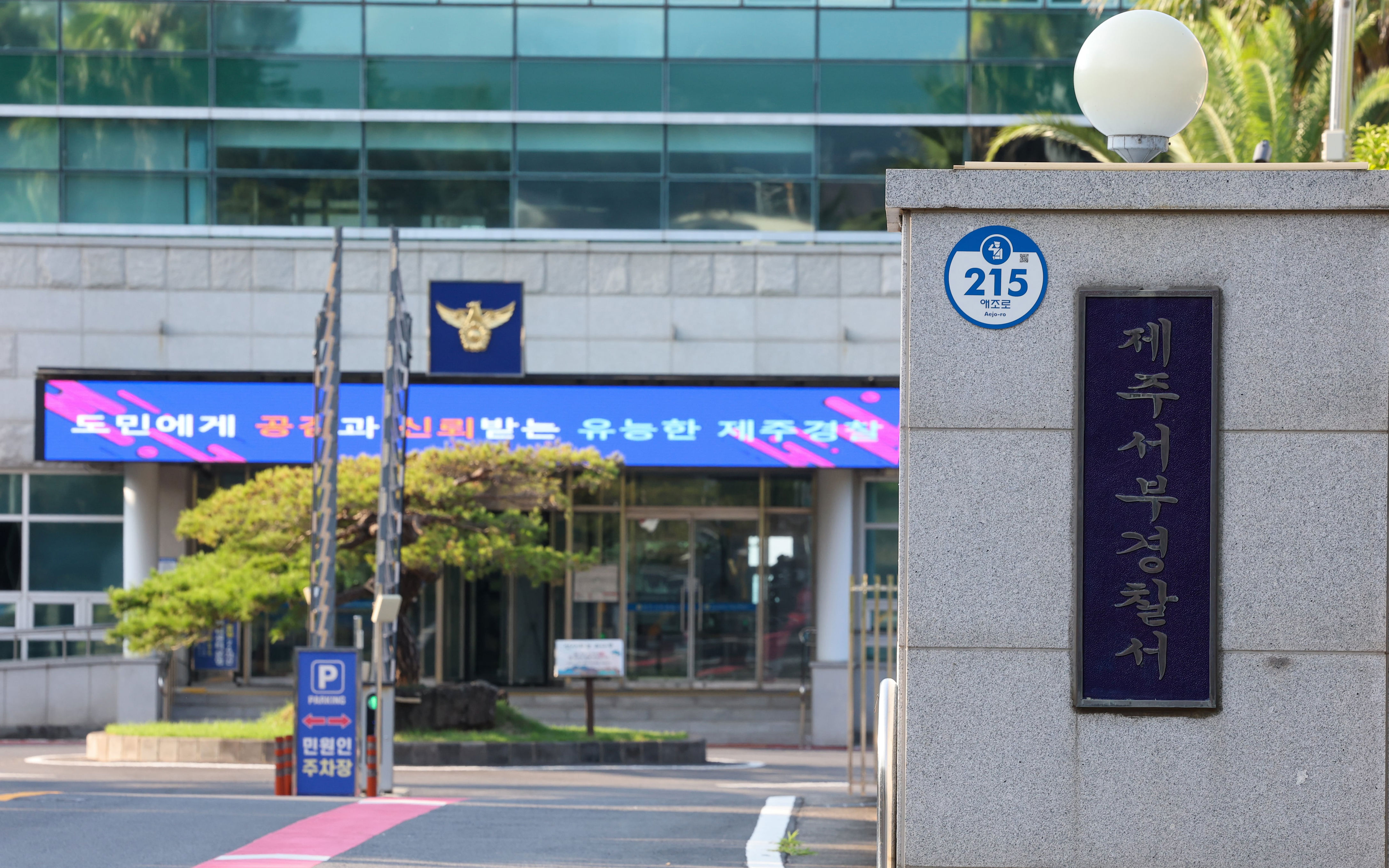
Claims have emerged that police in Jeju Island, investigating the case of Jang Mo (37), whose body was found after she went missing, only began securing CCTV footage near her residence around mid-August—just ten days ago. This was days before her family publicly released a missing person poster to the media on August 18. Reports indicate that police did not survey the area around her residence even after the second report was filed on July 19, and only belatedly started tracking her movements. It was previously revealed that the police sent an official request to access public surveillance footage in Jeju Island on July 19.
On the 26th, neighbors of Jang met by this newspaper stated, “Police first came around mid-month. It’s only been ten days,” and added, “It seems they only searched the sea area.” Initially, police had claimed, “While the area near her residence was part of the initial search scope, we were short-staffed and couldn’t examine it thoroughly at the time.” However, if no search was conducted near her residence, this explanation would be entirely contradictory.
Kim Sook-ja (70), a resident near Jang’s residence, said, “The police came and asked to view the CCTV because there was a missing person case.” Kim added, “When I asked if it was a young person, they only replied, ‘A person from Hallim,’ so I didn’t know if it was someone from here,” pointing to Jang’s residence 200 meters away. Another resident, Mr. A, claimed, “The police didn’t even inform us that it was a missing person case,” and said, “I thought it was a criminal case when they said they needed to check the CCTV to find someone.” In the three months that passed, the CCTV footage from these houses, which could have tracked Jang’s whereabouts, was automatically deleted.
Notably, Kim recognized Jang’s face. According to Kim, Jang would sit on the curb near her residence around 8 p.m. three to four times a week, looking across the road at a tractor and bushes while talking on the phone with acquaintances. Kim recalled, “She was a pretty young woman, and I wondered why she was sitting in such a dangerous place, so she stood out in my memory.” Several households besides Kim and Mr. A live near Jang’s residence. If police had requested cooperation from her neighbors even after the reinvestigation last month, the investigation progress might have differed.
However, when this newspaper reviewed the areas police reportedly searched, it was confirmed that for the past three months, police had only circled around accommodations near Hallim Port. While it is true that Jang’s mobile phone signal was traced to “Hallim Port,” due to Jeju’s geographical characteristics—where a single base station covers a wide area due to the lack of tall buildings—the error margin between Hallim Port and Jang’s residence, both under the same base station, is significant. Despite this, police focused their search on Hallim Port while excluding CCTV footage near her residence, which could have immediately revealed her movements. This approach has drawn criticism for being illogical.
Moreover, the number of accommodations in the Hallim Port area was not substantial enough to require multiple visits or a broad search. The area police concentrated on was a 150-meter-by-150-meter alley in Hallim Daily Market, containing nine motels and guesthouses—excluding one temporarily closed. Police reportedly visited six of these on May 15, the date of the first missing person report, and added the remaining three after the second report on July 19, repeating their visits over two months. It appears they expanded the search to accommodations outside Hallim Daily Market around mid-August, coinciding with their belated exploration of Jang’s residence.
Some accommodation owners in Hallim Daily Market expressed frustration with the police’s routine approach. Their questions were always the same: “Is there a long-term female guest?” or, showing Jang’s photo, “Has someone who looks like this ever stayed here?” Owner Mr. B sighed, “When I asked why they kept coming to the same place, they said they didn’t realize they’d been here before.” Owner Mr. C explained, “We don’t accept female guests in the first place.” Furthermore, the accommodation owners noted that these establishments are part of the police’s regular patrol route. Thus, it seems more natural to view the police’s actions as part of routine patrols rather than a special search for Jang’s case.
Jang’s body was found on the 24th, 104 days after her disappearance. It had already skeletonized. The location was a 10-minute walk from her residence, less than 1 kilometer away—the same area where she was first reported missing.
It was also revealed that after the second report on July 19, police wasted over three weeks searching for the call records between the nonexistent 34-year-old Senior Police Officer Bu and Jang. Only on the seventh day—19 days later—did they suspect Bu had falsely closed the case. Four days after that, on the 11th, they requested an investigation, and three days later, on the 14th, they began a full-scale probe. In total, it took 26 days for police to realize the initial report had been falsely dismissed and launch an investigation.
Regarding the question, “Why didn’t police search near Jang’s residence even after the second report?” Jeju Western Police Station, handling the case, explained, “Besides accommodations in Hallim Daily Market, we also canvassed saunas and convenience stores,” and added, “We gradually expanded the search, but due to staffing limitations, it was difficult to broaden the scope from the beginning.”
- 월 5900원 멤버십, 신문 독자에게는 2900원, 조선멤버십
- 55000원 상당의 신문-잡지 8종 마음껏 보기, 조선멤버십
- 현금처럼 쓸 7000포인트 받아 알뜰한 쇼핑, 조선멤버십
Post a Comment