
The proportion of multiple births, including twins and triplets or more, exceeded 6% for the first time last year. This is a result of an increase in older mothers undergoing in vitro fertilization (IVF) due to late marriages and other factors. The total number of births also surged by over 15% in the first half of this year, marking the highest growth rate since related statistics began. The increase is attributed to early 1990s-born individuals, who were born at a time when over 700,000 people were born annually, beginning to have children, along with positive shifts in perceptions surrounding marriage and childbirth, and various support measures from the government and local authorities.
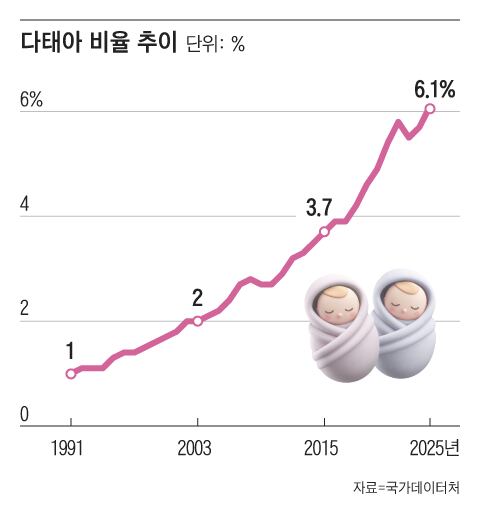
According to the ‘2025 Birth Statistics’ released by the Ministry of Data and Statistics on the 26th, there were 15,500 multiple births last year, accounting for 6.1% of all births. This marks the highest figure since related statistics began in 1991, surpassing the previous record of 5.8% set in 2022 after three years.
The rise of multiple births from 1% in 1991 to over 6% is attributed to the increasing number of older mothers. The likelihood of undergoing fertility treatments tends to rise with age. Additionally, the trend of implanting multiple embryos during IVF to increase success rates has led to more multiple pregnancies. Professor Park Jung-shin from Seoul National University College of Medicine, Department of Obstetrics and Gynecology, stated, “As the average age of pregnant women in South Korea rises, infertility cases increase, leading to more attempts at IVF and a subsequent rise in multiple births.”
The proportion of births to mothers aged 35 or older has been increasing. In 2025, 37.3% of births were to mothers in this age group, 1.6 times higher than a decade ago (23.9%). For mothers aged 40 or older, the proportion reached 6.4%.
Ms. Bae, 43 years old, and her husband, who have been raising fraternal twins for two years, are a case in point. After marrying five years ago, they chose IVF when natural conception did not occur as planned. They successfully had twins by implanting two of three embryos at once. Ms. Bae said, “Many of my older sisters and younger friends who married late ask about hospitals and doctors who succeeded with IVF, as well as various tips, and actively recommend pursuing twin pregnancies.”
The total number of births has also surged significantly this year. In the first half of 2026 (January–June), 145,804 births were recorded, a 15.4% increase from the same period last year. This marks the highest growth rate since statistics began in 1981. Births in the first half had declined for nine consecutive years from 2016 (214,703) to 2024 (117,280) but have now increased for two consecutive years, starting from 126,374 in 2025.
The increase in births is largely due to the second echo-boom generation (children of the second baby boomers, born between 1964 and 1974) entering their early to mid-30s, the prime childbearing age. Meanwhile, marriages—a leading indicator of births—have also risen. Couples who postponed marriage due to COVID-19 began marrying from the second half of 2022 to the first half of 2023, leading to a natural increase in births with a time lag. Additionally, as the government and local authorities expanded marriage incentives, more couples formalized their unions or registered marriages late.
According to the Ministry of Data and Statistics, the number of marriages in the first half of 2026 was 124,374 cases, a 5.5% increase from the previous year. This marks the fourth consecutive year of growth since a 9.2% increase in 2023. As a result, both births and marriages in the first half have risen for two consecutive years since 2025—the first such occurrence since 2006–2007.
Public perceptions among unmarried men and women regarding marriage and childbirth have also improved. In a March survey by the Presidential Committee on Ageing Society and Population Policy, 65.7% of unmarried respondents viewed marriage positively, a 9.8 percentage point increase from two years ago. Those expressing intent to have children rose from 29.5% to 40.7%, an 11.2 percentage point increase.
With the rise in births, the total fertility rate (the average number of children a woman is expected to have in her lifetime) is projected to reach around 0.9 people this year. The second-quarter fertility rate was 0.88 people, up 0.11 people from the same period last year. The total fertility rate, which stood at 1.05 people in 2017, fell below 1.0 the following year (0.98 people) and hit a historic low of 0.72 people in 2023. It rebounded to 0.75 people in 2024 and 0.8 people in 2025, marking two consecutive years of growth.
- 월 5900원 멤버십, 신문 독자에게는 2900원, 조선멤버십
- 55000원 상당의 신문-잡지 8종 마음껏 보기, 조선멤버십
- 현금처럼 쓸 7000포인트 받아 알뜰한 쇼핑, 조선멤버십
Post a Comment