
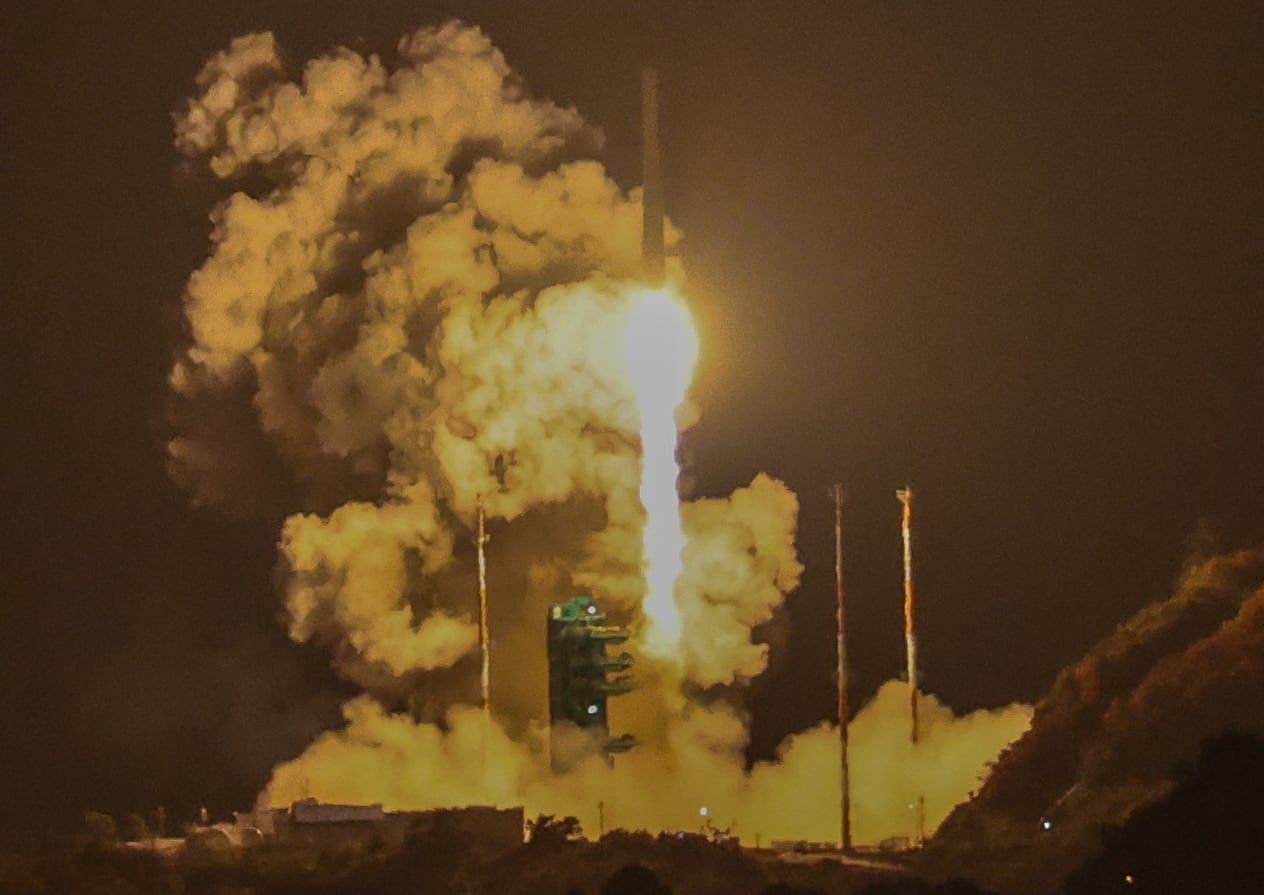
Nuri is set to embark on its fifth space flight on October 7, carrying a record 15 satellites. This mission will mark South Korea’s first attempt to deploy five clustered microsatellites into orbit simultaneously.
The Korea AeroSpace Administration announced on the 27th that the launch management committee, held in Sacheon, Gyeongsangnam-do, finalized October 7 as the target date for Nuri’s fifth launch. The launch window is scheduled between 12:23 p.m. and 1:23 p.m., with the exact time to be confirmed on the day based on weather and space environmental conditions. A backup period from October 8 to 14 has been allocated to account for unforeseen variables such as weather disruptions.
For this mission, Nuri will carry the KAIST Satellite Research Center’s microsatellite cluster units 2–6 as the primary payload. These clustered microsatellites are designed to operate collectively, enabling frequent observations of specific regions and rapid acquisition of high-resolution imagery. They will be utilized for disaster monitoring, national security, and other applications. Nuri is tasked with deploying these satellites into a sun-synchronous orbit at an altitude of approximately 500 km. The Korea AeroSpace Administration described this as the “first domestic mission to insert clustered satellites into orbit.”
Additionally, 10 CubeSats developed by domestic companies, universities, and research institutions will be co-launched. These include satellites designed to analyze marine debris movement around Jeju Island, monitor fine dust, measure space radiation environments, conduct protein crystal growth experiments in space, test optical communication technologies, and verify the performance of domestically produced satellite components. Daejeon Sat-1, developed with participation from Daejeon Metropolitan City, will observe urban spatial changes.
The 15 satellites aboard Nuri represent the highest number ever carried by the launch vehicle. In the third launch in March 2023, Nuri transported two next-generation small satellites and seven CubeSats, while the fourth launch in 2025 carried the Compact Advanced Satellite (CAS) 500-3 and 12 CubeSats. This fifth mission serves as a critical test of Nuri’s capability to function as a “space transport vehicle,” demonstrating its ability to deliver multiple satellites to their target orbits in a single launch.
The Korea AeroSpace Administration stated that preliminary reviews of launch conditions confirmed no immediate issues with weather, space environments, or collision risks with space debris.
Korea AeroSpace Administration Administrator Oh Tae-seog emphasized, “This fifth Nuri launch is a significant mission, carrying a record 15 satellites and marking the first domestic deployment of clustered satellites into orbit. It will serve as a pivotal step in advancing Nuri’s operational capabilities and solidifying its role as a reliable space transport system.”
- 월 5900원 멤버십, 신문 독자에게는 2900원, 조선멤버십
- 55000원 상당의 신문-잡지 8종 마음껏 보기, 조선멤버십
- 현금처럼 쓸 7000포인트 받아 알뜰한 쇼핑, 조선멤버십
Post a Comment