
A woman in her 60s recently visited a hospital after experiencing noticeable memory decline. Tests confirmed an early-stage Alzheimer’s disease diagnosis. In the past, available medications primarily aimed to moderately alleviate memory deterioration. Now, antibody therapies that locate, bind to, and remove abnormal amyloid beta proteins accumulating in the brains of Alzheimer’s patients are being used.
Similar advancements are occurring in cancer treatment. For breast cancer patients with excessive HER2 protein on their cancer cell surfaces, antibodies targeting HER2 are administered to block cancer drivers. In rheumatology and gastroenterology clinics treating rheumatoid arthritis or inflammatory bowel disease, antibodies that block core disease mechanisms have become familiar tools. This marks the golden age of antibody therapies.
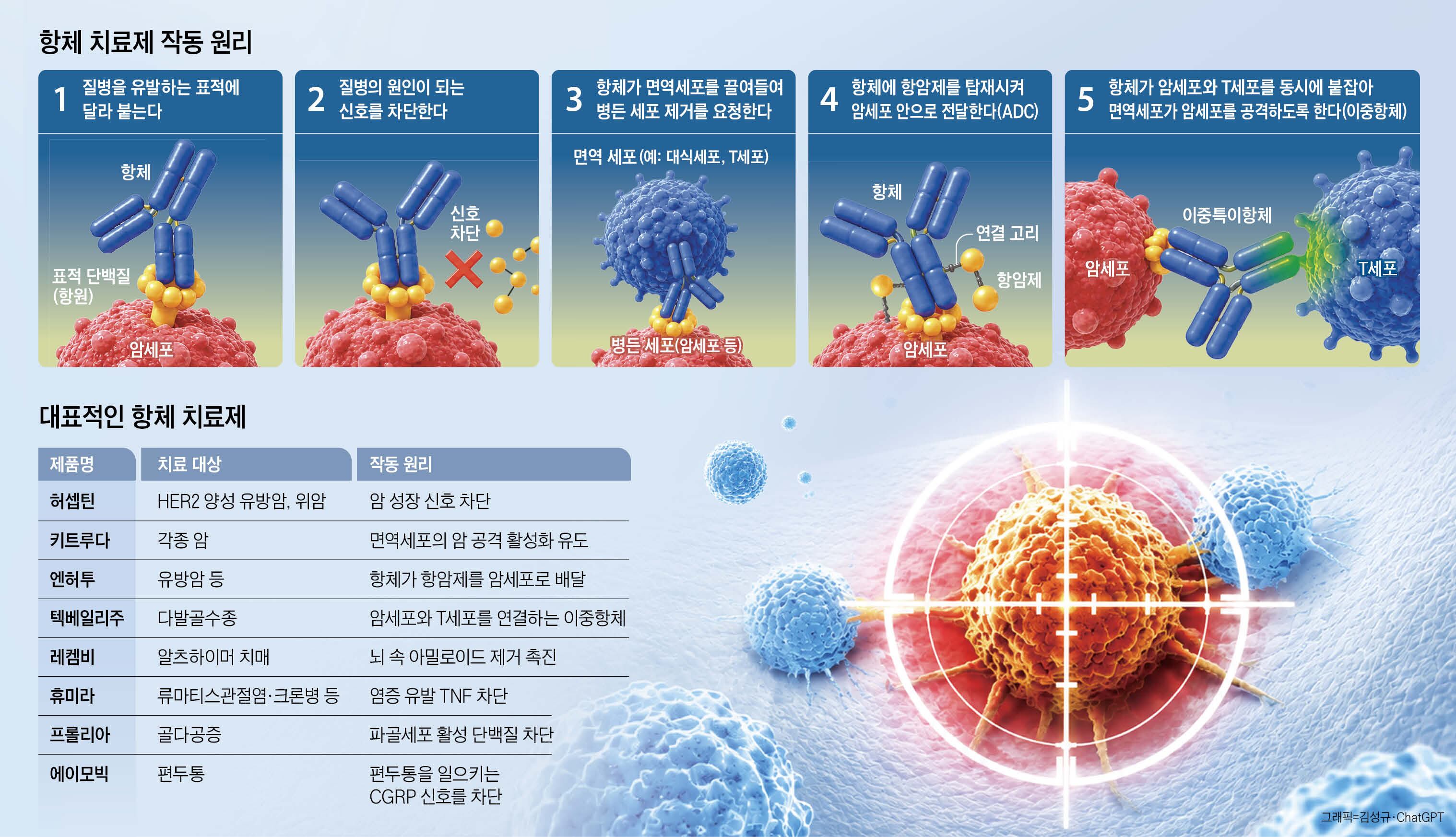
Fifty years after the advent of monoclonal antibody technology—which binds to a single site on an antigen—the 2025 journal *Nature Reviews Immunology* reported that at least 212 antibody therapies have been globally approved, treating tens of millions of patients.
Antibodies’ defining feature is selectivity: they identify and bind to specific targets among countless proteins. This precision earns them the analogy of “guided missiles.” They can home in on proteins overabundant in cancer cells or block specific inflammatory signals in autoimmune diseases.
The most rapidly evolving field for antibody therapies is oncology. Antibodies “read” cancer cells’ molecular markers. Cancer cell surfaces host antigens critical for tumor growth; HER2 is a prime example. In some breast cancers, HER2 is overexpressed. Antibody therapies targeting HER2 have significantly improved outcomes for HER2-positive breast cancer patients (refer to the antibody therapy case graphic). These therapies have redefined cancer treatment: whereas location once dictated therapy, molecular markers now guide treatment selection.
Recent innovations involve antibody-drug conjugates (ADCs), where antibodies deliver potent anticancer drugs into cancer cells. ADCs consist of an antibody, a linker, and a drug. The antibody acts as a navigation system, binding to a cancer cell’s surface protein. This triggers drug internalization; the linker then breaks, releasing the drug to kill the cell. ADCs are expanding beyond breast cancer to lung, gastric, and blood cancers.
Antibody therapies have advanced further with bispecific antibodies. While conventional antibodies target one antigen, bispecific antibodies can bind two distinct targets simultaneously. One arm attaches to a cancer cell, the other to a T-cell, forcing them to interact. This enables immune cells to directly attack and destroy cancer cells.
Alzheimer’s disease exemplifies the expanding scope of antibody therapies. Amyloid beta proteins abnormally accumulate in patients’ brains. Antibody therapies bind to specific amyloid beta forms, prompting brain immune cells to clear them and reduce amyloid levels.
Cancer specialists note, “Future treatment outcomes will depend on which drugs are attached to antibodies, how many are linked, and how immune cells are directed to tumors.” They add, “We’re entering an era where antibodies target cancer cells, clear dementia-related proteins, and switch off inflammation.”
- 월 5900원 멤버십, 신문 독자에게는 2900원, 조선멤버십
- 55000원 상당의 신문-잡지 8종 마음껏 보기, 조선멤버십
- 현금처럼 쓸 7000포인트 받아 알뜰한 쇼핑, 조선멤버십
Post a Comment