
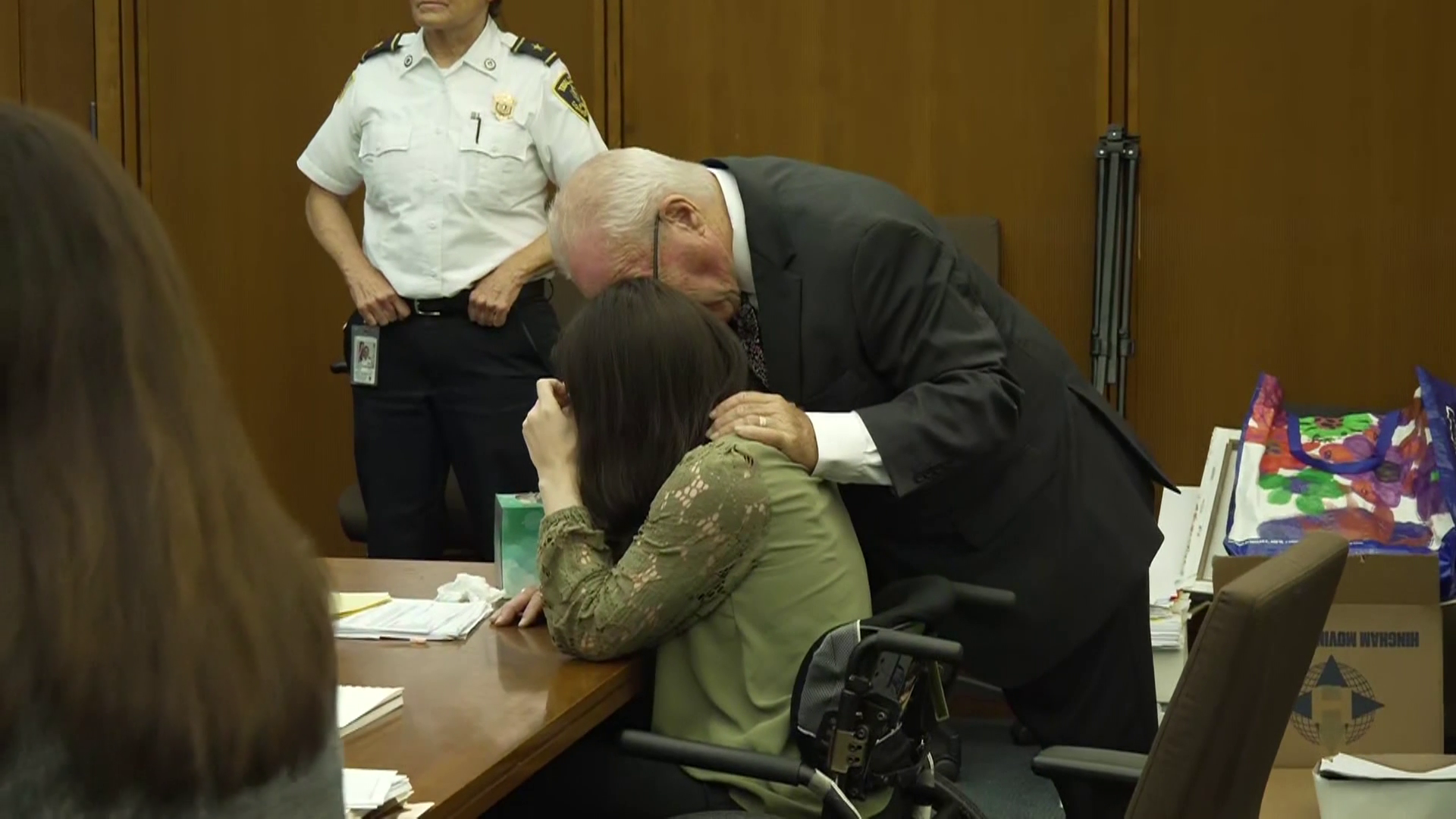
Lindsay Clancy, the Massachusetts mother accused of strangling her three kids in their Duxbury home in 2023, cried loudly as a doctor described the findings of her daughter's autopsy.
 Sign up for our Newsletters
Autopsy testimony
Dr. Barbara Olson, of the Office of the Chief Medical Examiner, was called to testify Wednesday afternoon about the autopsies of Cora and Dawson Clancy.
At one point, she described the injuries to Cora's neck, identifying signs of ligature strangulation, and describing the pain that it would cause. Olson also described hemorrhaging suffered by Dawson, which she said could be caused by him struggling or by changes in the pressure of the ligature.
Lindsay Clancy was crying loudly with her head on the table throughout the testimony. At one point, reporters in the room heard her say, "I can't do it."
She wasn't the only one crying. Reporters observed at least one tearful juror.
Citing the nature of the autopsy images, the court has ordered that they not be shown to the public. The images were shown on monitors visible to the jury but not the spectators in the gallery.
Lindsay Clancy was also seen crying throughout the testimony of another medical examiner who testified last week about the autopsy of her son, Callan Clancy.
Video: Former judge chimes in on Clancy's emotions during trial
Mass. State Police sergeant on stand
Jurors heard testimony Wednesday from a Massachusetts state police sergeant who was assigned to watch Lindsay Clancy at the hospital after the deaths of her children.
Sgt. Dan Lawlor said he assisted with Clancy’s custody after she was accused of strangling her children in the family’s Duxbury home in 2023.
Lawlor said that while he was at the hospital, a doctor came to meet with Clancy and entered her room. He said he did not hear their conversation.
During cross-examination, Clancy’s lawyer questioned Lawlor about a theory he claimed the prosecution was advancing.
Video: State police sergeant, clinician testify in Clancy trial
"Did you talk to McDuligan about the theory that Doctor Ziezel is the reason that she told her husband that she heard voices?" Kevin Reddington asked.
"Yes," Lawlor said.
The prosecutor then asked Lawlor about the investigative process.
"Is it to say you will oftentimes have conversations as the investigation is unfolding with other investigators that you’re working on a case with about the case, potential evidence?" the prosecutor asked.
"Yes," Lawlor said.
"Fair to say theories change over time based on your investigation, what evidence you find?" the prosecutor asked.
"Correct," Lawlor said.
Patrick Clancy previously testified that Lindsay had told him about hearing voices during a phone call a week after the killings, saying she had never mentioned hearing voices before.
After Lawlor, jurors heard from a clinician who previously worked at the South Shore Hospital perinatal clinic, where Clancy was treated in the months before the killings.
Nurse practitioner testifies
On Tuesday, jurors heard from a psychiatric nurse practitioner who treated Lindsay Clancy in the months before the children's deaths. Rebecca Jollotta works at South Shore Hospital and said she started meeting with Lindsay Clancy in November 2022.
Jollotta said the defendant feared she might be addicted to Ativan — an anti-anxiety medication — and was relying on it to sleep.
Clancy's defense is arguing that she was not criminally responsible because she was suffering postpartum psychosis. Jollotta testified that Clancy suffered serious depression, anxiety and sleep problems but repeatedly showed clear thinking and no signs of psychosis or mania.
Also Monday, Dr. Jennifer Tufts, who was first questioned by the prosecution on Friday, was cross-examined by the defense throughout Monday morning. Defense attorney Kevin Reddington pressed Tufts over months of telehealth treatment, medication decisions and responses to Clancy's worsening mental health.
Tufts is one of the defendants named in civil lawsuits filed in January by both Lindsay Clancy and her ex-husband, Patrick Clancy. Those cases accuse Tufts, other providers and hospitals of failing to properly diagnose and treat her mental illness.
TikTok witness debated
Judge William Sullivan is weighing whether Lindsay Clancy's defense can call a former McLean Hospital employee as an additional witness after prosecutors objected that she has no firsthand knowledge of Clancy's stay at the hospital.
Defense attorney Kevin Reddington argued Tuesday morning that jurors had been left with an overly favorable impression of McLean Hospital and that the former employee could counter it. The judge questioned the relevance because she left roughly a year before Clancy's admission.
Prosecutor Shanan Buckingham argued the proposed witness is not an expert, lacked knowledge of McLean during Clancy's stay and has followed the trial on TikTok. The notes also attribute to Buckingham a claim that the woman called the prosecution “an abomination.”
In his questions, Sullivan appeared to focus on whether the proposed witness could speak meaningfully about McLean's staffing and conditions during Clancy's stay around New Year's 2023. He suggested records or someone working at McLean during that period could provide more relevant information. He took the issue under advisement and suggested that he might be willing to evaluate the witness through voir dire without the presence of the jury.
Background of the Clancy case:
- Lindsay Clancy, 36, faces three murder charges in the 2023 deaths of her children, Cora, Dawson and Callan.
- She also jumped from a second-floor window, leaving her partially paralyzed.
- In a civil case, Lindsay Clancy alleges a "catastrophic failure" of multiple medical providers in diagnosing and treating her psychiatric condition.
- Her trial began on July 20. Although her legal team offered to stipulate to the deaths of the children, she has pleaded not guilty.
- She is being held at Tewksbury State Hospital.
- The jury is made up of 12 women and six men. They will not know until the presentation of the case is concluded who will deliberate and who will be an alternate.
This case involves issues of mental health. If you or someone you know needs help, you can talk with the Suicide & Crisis Lifeline by calling or sending a text message to 988, or you can chat online here.
Key moments from week 2
- Christopher Clancy, father of Patrick Clancy and grandfather of the children, described the call he received from his son after the children were killed. "It was terrible," he said.
- Clancy cried Thursday during the testimony of Dr. Kimberley Springer, a medical examiner, who described images from the autopsy of Callan Clancy in January 2023.
- Former nanny Elaine Rossi, who cared for infant Callan Clancy beginning in September 2022, testified she communicated with Clancy daily through text messages and a notebook containing detailed instructions about Callan's feeding, sleep schedule and daily routine. Rossi described Clancy as a "wonderful mom" and testified she never believed the children were unsafe. She also said Clancy spoke about struggling with postpartum issues, difficulty sleeping and seeing doctors for treatment.
- Prosecutors read entries from the notebooks describing Clancy feeling overwhelmed by her son Callan's sleep schedule. On cross-examination, the defense highlighted other entries in which Clancy wrote about wanting to get well, brain fog, guilt, anxiety and concerns about returning to work.
- Clancy's attorneys have asked a Plymouth Superior Court judge to allow three defense witnesses to testify after prosecutors objected to their inclusion, arguing the testimony is central to her defense. Her motion asks the court to permit testimony from Dr. Elizabeth Laposata, Dr. Michael Vulfovich and Dr. Donald Condie.
- Physicians and nurses testified about Clancy's injuries when she arrived at the ICU at Brigham and Women's Hospital early in the morning on Jan. 25. One of the nurses described that Clancy, who was intubated, was able to use a whiteboard to communicate her confusion and inability to feel her legs.
- Judge William Sullivan paused before Friday's lunch break during the emotional trial of Lindsay Clancy to admonish everyone in the courtroom to beware of making inappropriate remarks.
- Jurors heard that Clancy voluntarily checked herself into McLean Hospital early on New Year's Day with suicidal thoughts, anxiety, and an inability to sleep. Dr. Alia Goodheart said she met with Clancy for an evaluation several days later and assessed that Clancy had no plan for suicide. Goodheart said Clancy expressed that her children and her family were reasons she would not commit suicide.
- Jurors also heard the start of the testimony from Dr. Jennifer Tufts, one of the defendants named in civil lawsuits filed in January by both Lindsay Clancy and her ex-husband, Patrick Clancy. Tufts testified that her initial diagnosis was adjustment disorder with depressed mood and generalized anxiety disorder. She said that she recommended medication to Clancy, but that Clancy was reluctant.
More key takeaways from the trial are here.
Key moments from week 1
- The first week of testimony in the Lindsay Clancy murder trial ended after the judge, jury and attorneys visited locations connected to the case, including the Clancy family's former home in Duxbury. The jury also retraced the route prosecutors say Lindsay Clancy sent her husband, Patrick Clancy, on the day of the killings, including stops at a CVS and a restaurant in Plymouth.
- Jurors heard the gut-wrenching 911 call Patrick Clancy made after he found his young sons and daughter with exercise bands around their necks. He testified about returning home from a trip to pick up dinner and medication, finding blood in the bedroom and his wife out in the yard. While on the phone with a 911 operator, he asked her what happened and went inside, where he found the children in the basement.
- Plymouth County Assistant District Attorney Shanan Buckingham used her opening statement to tell the jurors that the children were strangled "meticulously." She warned the jurors they would hear graphic testimony as she urged the group to use their common sense and life experiences as they listen to the case.
- Defense attorney Kevin Reddington said his client knows she killed her children but questioned what was going on in Lindsay Clancy's mind. He is arguing that she suffered from postpartum psychosis and was overmedicated at the time of the alleged crimes.
TOP STORIES FROM WCVB:
Police: Man fatally stabbed during fight at South Station
Hazmat responds after 'unusual odor' reported at Boston residential building
Pregnant woman held hostage in pursuit, crash during morning commute
Plane crashes while landing at airport in NH; FAA investigating
Marine veteran from Lowell back on US soil after detainment in Russia
Hundreds of meteors expected to light up the sky during Perseids peak
READ THE FULL STORY:Lindsay Clancy sobs through autopsy testimony
CHECK OUT WCVB:Get the latest Boston news, weather and sports online, anytime. Stay in the know with Boston’s news leader – WCVB.
Post a Comment