
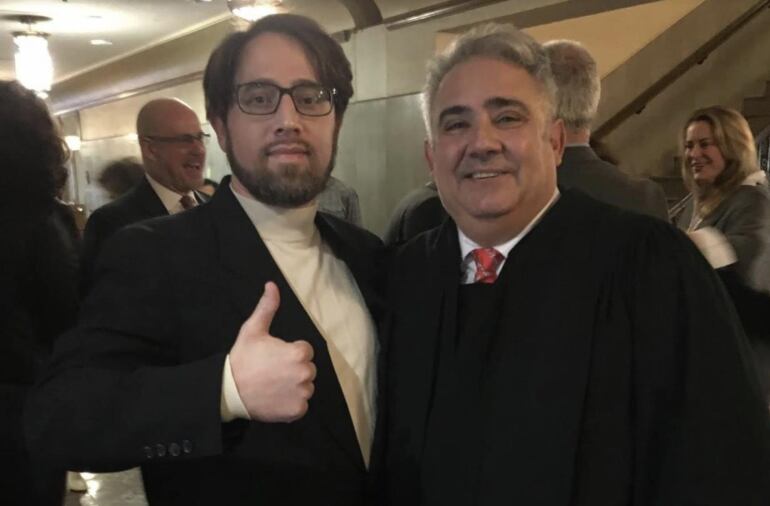
LUBBOCK, Texas (KCBD) - Eric Smith spent years convinced he was secretly working with the FBI, decoding assassination plots against world leaders. He wasn’t. He was in the grip of a severe mental health crisis — and no one could legally force him to get help.
A diagnosis and a warning
As a child, Smith excelled in honors classes, but his mental health began to unravel in his teenage years. His parents took him to a psychologist who diagnosed him with bipolar disorder and issued a warning to the family.
“He said, and don’t be surprised if when Eric hits his mid-20s or so, he falls ill with some sort of psychosis, some type of psychotic spectrum disorder,” Smith said.
Smith said more than a decade of medications failed him — sometimes five to eight pills a day. He also started using drugs recreationally, making it harder for doctors to pinpoint what they were treating.
Psychosis takes hold
Then, just as that doctor had predicted years earlier, Smith’s psychosis took hold. His paranoia grew so severe he believed he had uncovered an international assassination plot.
“I Googled the FBI’s phone number, and I called them to tell them about these assassination plots,” Smith said.
The FBI met with Smith — which only deepened his delusion. As his condition spiraled, Smith’s parents reached out to his most recent psychiatrist for guidance.
“The best bet Eric has of getting psychosis managed and finding some path back to reality is if he gets arrested for a low-level, non-violent offense and then while in jail it gets flagged for mental health and then a judge orders someone to interact with him to find out if he should be transported to a hospital involuntarily,” Smith said, recounting what the psychiatrist told his family. “That is the path that Eric gets into treatment because he is not going to accept treatment on his own and he is not going to meet the high bar for involuntary hospitalization.”
Arrest leads to treatment
Eventually, Smith was arrested for trespassing on his parents’ San Antonio-area property — exactly the scenario his psychiatrist had predicted would be his only path to treatment.
The KCBD Investigates Team spoke with a judge, prosecutors, a defense attorney, law enforcement, and mental health professionals, all of whom said people cycle through the criminal justice system every day without ever getting sustained treatment.
Texas Tech Law Professor Brian Shannon, who also serves on the Texas Judicial Commission on Mental Health, said Assisted Outpatient Treatment programs — like the one in Bexar County — are designed to break that cycle. AOT programs allow a judge to order adults with a severe mental illness into community-based mental health treatment.
Bexar County Judge Oscar Kazen created and implemented the first fully operational civil AOT program in Texas. Shannon said Kazen’s approach centers on bringing all parties together.
“He brings the whole team in, the person who’s subject to the order, somebody from the prosecutor’s office, the defense lawyer, the treatment team,” Shannon said. “And he’ll ask some basic questions like, how are you doing this week? Did you take your meds? Did you go to your appointment? Anything I should know? And he said, just with that judicial involvement, bringing the people together, they reduce their hospital bed days significantly, more than halved them, and better outcomes for the people.”
‘The judge’s authority’
Smith said he was fortunate to have been arrested in Bexar County because Kazen sent a court liaison to meet with him in jail. Smith was then transferred to the San Antonio State Hospital, stabilized involuntarily for three months, and released into Kazen’s AOT program.
Smith said the judge’s presence in those AOT hearings cut through the psychosis.
“The judge’s authority and holding other people accountable for my own good — at least had me willing to entertain the idea of, okay, yeah, I’ll keep taking my meds, I’ll keep showing up to these hearings, I’ll keep doing this,” Smith said.
Smith said people in crisis rarely know they need help, making voluntary treatment nearly impossible.
“Involuntary hospitalization and AOT temporarily restrict a person’s freedom to restore freedom. But the freedom that’s temporarily being restricted — I would argue as someone who’s been through it — is no freedom at all,” Smith said.
Recovery and a new role
Smith went through three hospitalizations before doctors found a medication that worked.
“Absent assisted outpatient treatment and absent involuntary hospitalization working in concert that got me to that point of getting me to that medication... I’m six feet under by now,” Smith said.
The man who once dropped out of high school — lost in psychosis — went on to earn a master’s degree with a perfect 4.0. Smith said he now runs his own company and serves as a commissioner on the Texas Judicial Commission on Mental Health, where he shares his story to help shape policy for others.
“All AOT is not created equally. I just happened to hit the jackpot and fall into AOT here in Bexar County where Judge Oscar Kazen really understands the finer nuances of people who find themselves in AOT,” Smith said.
Lubbock County stakeholders are now researching the Bexar County model and others in hopes of giving people the same opportunity Smith received.
Post a Comment