
The Bank of Korea significantly raised its economic growth forecast for this year to 3.3%, reflecting strong semiconductor exports and expanded related investments. While maintaining the consumer price inflation forecast at 2.7%, the central bank increased its core inflation outlook, excluding volatile food and energy prices.
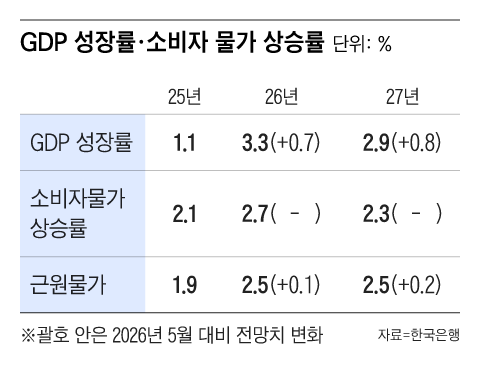
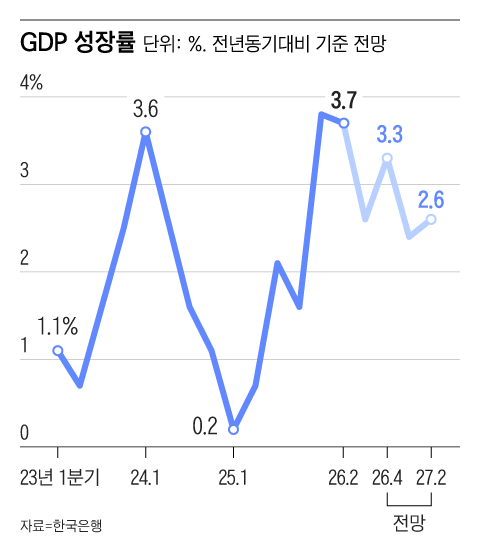
In its economic outlook released on the 27th, the Bank of Korea raised its real gross domestic product (GDP) growth projection for 2026 from 2.6% to 3.3%, an upward revision of 0.7 percentage points. The central bank had previously adjusted its growth forecast upward from 2.0% to 2.6% in May. The 2027 growth forecast was also revised upward by 0.8 percentage points, from 2.1% to 2.9%.
The central bank cited the semiconductor industry’s strong performance as the primary driver behind the upward revision. It noted that semiconductor export volumes and prices exceeded expectations, while expanded exports of AI-related items contributed to a 0.35 percentage point increase in the growth forecast. Upward revisions to preliminary GDP data for last year and the first quarter of this year added another 0.2 percentage points. Accelerated investments in the government’s ‘three major mega projects’—semiconductors, AI data centers, and physical AI—along with smaller-than-expected impacts from the Middle East conflict, each contributed 0.1 percentage points. However, stock market adjustments and rising market interest rates offset growth by 0.05 percentage points. The total upward revision amounted to 0.7 percentage points.
The Bank of Korea explained that the second-quarter GDP grew by 0.6% quarter-on-quarter, driven by strong semiconductor exports and recovery in consumption due to supplementary budgets, despite energy supply shocks from the Middle East being mitigated by government policies. While growth is expected to slow to 0.3% in the third quarter due to a high base from previous quarters, it is projected to rebound to 0.5% in the fourth quarter.
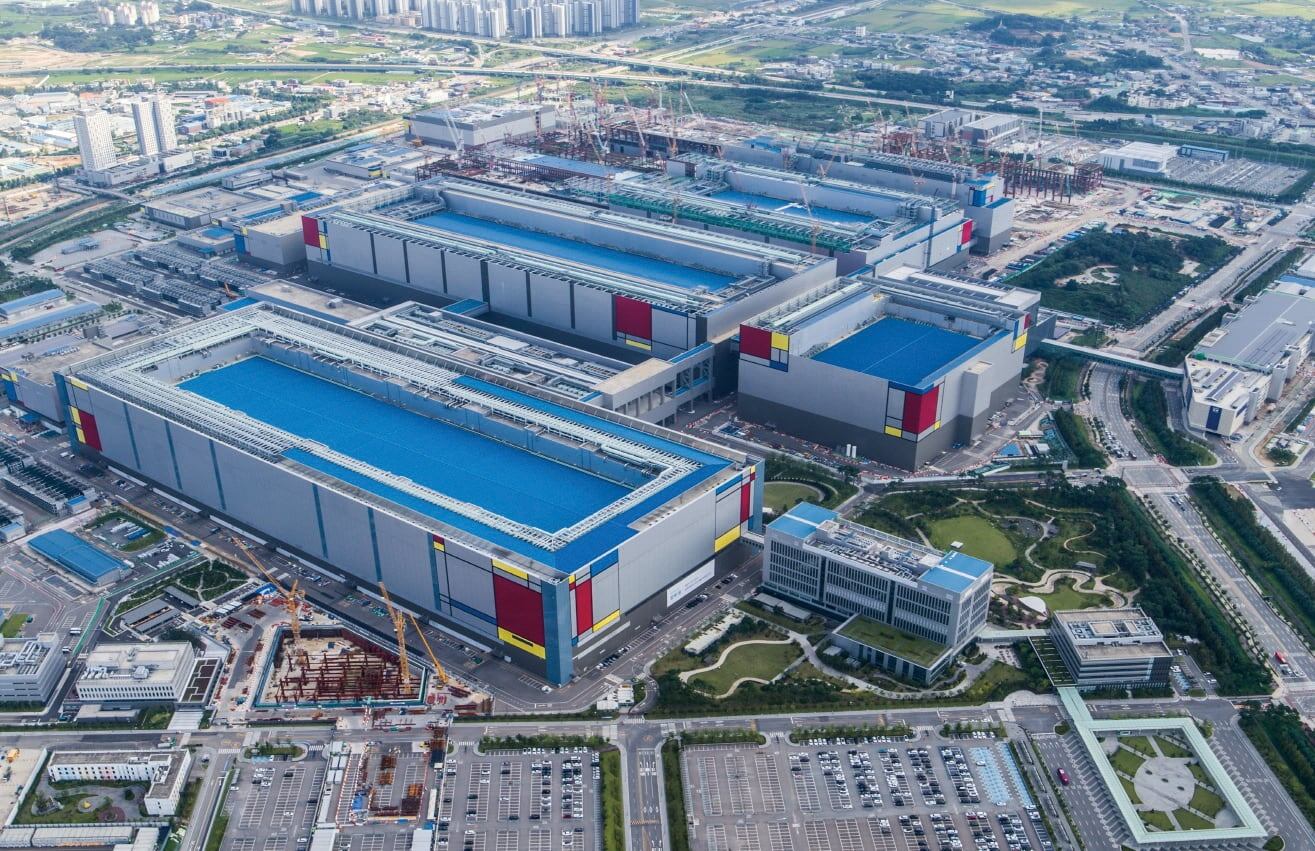
The effects of the semiconductor boom are expected to extend beyond exports to investment and consumption. The central bank raised its goods export growth forecast from 4.9% to 9.7%, anticipating increased demand for semiconductors and storage devices for AI data centers, alongside recovery in non-IT sectors like steel, metals, and machinery. It forecast the semiconductor upturn to continue at least until the first half of 2027. Lee Dong-ryul, head of the Bank of Korea’s research department, stated during the economic outlook briefing, “The timing of the semiconductor cycle’s peak after the first half of next year will depend on the sustainability of AI demand and the speed of supply expansion by semiconductor companies.”
The equipment investment growth forecast was raised from 4.4% to 6.8%, as semiconductor firms are expected to accelerate production capacity expansions to meet global demand. Private consumption is projected to increase by 2.1%, up 0.1 percentage points from the previous forecast, supported by improved income conditions from the semiconductor boom. Next year, the ripple effects of the semiconductor upturn on household income, employment, and consumption are expected to grow stronger. Lee noted, “Next year, semiconductor companies are likely to significantly expand bonus payments, and employment spillover effects will also increase. If consumption recovery spreads to various items, the ripple effects of the semiconductor boom will grow further.” The 2.9% growth forecast for next year is expected to be driven equally by domestic demand and exports.
In contrast, the construction investment growth forecast was lowered from 0.6% to 0.2%, as rising construction costs, market interest rates, and unsold housing inventory in non-capital regions are expected to slow recovery, despite increased investments in semiconductor factories and data centers.
The Bank of Korea maintained its consumer price inflation forecast at 2.7% for this year, citing expectations that oil price increases will slow toward the end of the year. However, it noted that high raw material and exchange rate costs, combined with consumption recovery amid economic growth, will sustain upward price pressures. While agricultural, livestock, and fisheries product prices may face short-term upward pressure due to heatwaves, government stabilization measures are expected to mitigate this.
The core inflation forecast (excluding volatile food and energy prices) was raised from 2.4% to 2.5%, as rising semiconductor prices are expected to influence durable goods like IT devices and electric vehicles, with travel-related service prices remaining high. Next year’s consumer price inflation forecast was maintained at 2.3% due to falling international oil prices, but the core inflation forecast was raised from 2.3% to 2.5%.
Lee stated, “Both consumer and core inflation are unlikely to fall to the Bank of Korea’s 2% target until next year. While consumer prices will slow due to falling oil prices, core inflation will remain high due to accumulated cost pressures and economic recovery-driven price increases.”
The Bank of Korea identified global AI investment speed, semiconductor cycles, Middle East developments, and U.S. tariff policies as key variables affecting future economic growth. It also noted that the direct benefits of the semiconductor boom may be concentrated in specific industries and groups, potentially limiting broader economic spillover effects.
- 월 5900원 멤버십, 신문 독자에게는 2900원, 조선멤버십
- 55000원 상당의 신문-잡지 8종 마음껏 보기, 조선멤버십
- 현금처럼 쓸 7000포인트 받아 알뜰한 쇼핑, 조선멤버십
Post a Comment